Johnson City, Tennessee is not a major tourist destination and not an area that people typically go to unless they have a very specific reason for going there or are driving on I-81 between Knoxville, TN and Bristol, TN. East Tennessee State University which is located in Johnson City is also a very unassuming place that many people outside of the region have likely not heard of. But within this region sits the East Tennessee State University and General Shale Brick Natural History Museum and Visitor Center (what I will call the Gray Fossil Site from now on) (Wikipedia page)a small but impressive museum that opened its doors in 2007.
Before I get to the review of the museum let me provide a little context as to why this museum exists, and I should point out this is just a brief summary and in no way will incorporate all of the details (see a longer and more through history here on the museum's website). Sitting directly in front of the museum is Tennessee State Route 75 which makes a large arc in front of the museum, the reason for the arc and the museum are intertwined. In 2000 the state was doing road work to widen Route 75 and as anyone who has spent time in that are of the country knows there are plenty of little hills that have been cut to the the roads where they need to get to. During the widening of the road the construction workers stumbled across some fossilized remains so they called out a paleontologist to investigate. After an initial investigation Dr. Steven Wallace realized that the site was much bigger than just the small area where the road was being widened. The governor at the time Don Sundquist along with others in the state agreed that the area should be preserved so the road was moved around the site and a museum was built to house the fossils found at the site as well as to display some of the fossils and educate the public about what had been found.
Being a museum on the site of discovery makes understanding the geology of the area important. The site sits in the Ridge and Valley Geologic Providence of the United States, the basics of which I have covered before (see here and here). The Ridge and Valley is characterized by limestone based valleys surrounded by sandstone capped ridges. This site sits in one of the limestone valleys, which as I have discussed before (here and here) limestone is easily dissolved away. The dissolving of limestone, in this case, created a sinkhole during the Miocene, the age of most of the fossils in the site, which infilled with water and therefore attracted wildlife to the site. One of the most common finds at the site are tapirs which along with several other animal and plant fossils help indicate the area was heavily forested at the time. Another fossil that tells us a great deal about this portion of North America during the Miocene is the presence of alligators which indicate a much warmer environment that was is found in the region today.
The museum itself is much bigger than one might expect from the area and is quite well done inside. After walking into the main entrance and finding out why there are so few, non-avian, dinosaurs in Tennessee and none in the area there is a little seating area. This seating area has a short video presentation on the history of the site and the importance of the finds from the site. Around the video area is an amazing painting covering the wall depicting a more Miocene like environment. After watching the video the visitor then follows the path into the main display area. Here are wonderful displays of fossils that unlike the old static displays one typically thinks of with museums show an active scene. An alligator is jumping out and attacking a tapir while life continues on around them. Around the outer wall are many smaller fossils including plant fossils and animal teeth. Displays of these type of fossils were typically not put on in the museums of old but as these fossils are as important, if not more so, to the understanding of a site more and more museums are putting them on display as well. In this area you also find out about the discovery of a red panda (although from a different genus and species from the one in the link) from the site, there are now at least two known from the site, which is important to understanding the history of red pandas as well as being cool as well. The Miocene section also has multiple drawers and areas where visitors can learn more about the animals found at the site as well as what the site teaches us about the area at the time. Most of these are clearly aimed at children but that doesn't make them any less informative. The next area of the museum is a smaller area that talks about the Pleistocene of the area. While only a small amount of this comes from the site specifically much more is known from local cave sites as well as a continuing excavation of a Pleistocene sinkhole site from Saltville, Virginia. The last few rooms of the museum show what it is like to be a paleontologist, including the typical kids excavation station where kids can "dig out" fossil casts and an area that describes how a specimen is jacketed from the field and then put back together for display/continued research. The upstairs of the museum has a window that looks in on students, volunteers, and scientists who are in the process of preparing specimens for display/research from the field. There is also a window that looks in on the main reason for such a large museum, the massive collections room where specimens that have been cleaned and repaired are put into storage for future research. The room is huge and has many cabinets full of fossils that have been excavated from the area. After looking in on collections one can walk out on a short walkway that overlooks the actual site and can, during most summer days, see a field crew of students and volunteers doing an excavation of fossil remains and preserving all of the sediment in bags for future screening for potential remains that are too small to readily be noticed. The site is huge and goes down a fair distance into the sediment below which, along with continued expansion to eventually get the whole sinkhole within the property of the museum, will assure many more years of excavation and future research.
As I mentioned when I started the Gray Fossil Site is not something you will just stumble upon but I highly recommend it. The museum is large but is easy to stop through if you just happen to be heading through the region, maybe to catch a race in Bristol. I highly recommend it and it is a unique chance to learn about when alligators, tapirs, and even red pandas roamed eastern Tennessee and when the climate of the region was much different than what is experienced in the region today.
Museum visits page
Showing posts with label science education. Show all posts
Friday, January 11, 2013
Monday, March 12, 2012
Pterosaur Launch and Flight
This is an interesting talk, at least to someone who is interested in pterosaurs, by Dr. Michael Habib on how the giant pterosaurs may have been able to launch and fly. And good job by the Royal Tyrrell Museum for posting this talk.
Thursday, February 9, 2012
Climate Change is Real!
This week's eSkeptic featured an article by Dr. Donald Prothero in which he discusses climate change; how we know it occurring, how we know we are causing it, and why people try to deny it. It is overall a good article and he presents many facts so I recommend you read it in its entirety (this link will skip the heading portion of this week's eSkeptic) but I wanted to focus on one thing he said.
“I agree that climate is changing, but I’m skeptical that humans are the main cause, so we shouldn’t do anything.” This is just fence sitting. A lot of reasonable skeptics deplore the “climate denialism” of the right wing, but still want to be skeptical about the cause. If they want proof, they can examine the huge array of data that directly points to humans causing global warming.20 We can directly measure the amount of carbon dioxide humans are producing, and it tracks exactly with the amount of increase in atmospheric carbon dioxide. Through carbon isotope analysis, we can show that this carbon dioxide in the atmosphere is coming directly from our burning of fossil fuels, not from natural sources. We can also measure oxygen levels that drop as we produce more carbon that then combines with oxygen to produce carbon dioxide. We have satellites in space that are measuring the heat released from the planet and can actually see the atmosphere get warmer. The most crucial proof emerged only in the past few years: climate models of the greenhouse effect predict that there should be cooling in the stratosphere (the upper layer of the atmosphere above 10 km (6 miles) in elevation, but warming in the troposphere (the bottom layer of the atmosphere below 10 km (6 miles), and that’s exactly what our space probes have measured. Finally, we can rule out any other culprits (see above): solar heat is decreasing since 1940, not increasing, and there are no measurable increases in cosmic radiation, methane, volcanic gases, or any other potential cause. Face it—it’s our problem.I will admit I was at this point for a few years as well but it is the combination of all the evidence that he mentions, along with other pieces of evidence, that eventually made me realize I was wrong. That is how science works and that is why people who are ignoring the science of climate change are wrong.
Tuesday, February 7, 2012
Deep Time
As a geologist I try my best to understand deep time. Deep time refers to the history of the planet that we find in the fossil record as well as within the rock record and in what we can see in outer space about the formation of the universe. I try to reach out to make it accessible to everyone who is a reader of this blog and try to make it accessible in some of the long running series that I have such as the National Park Service series in which I try to incorporate geology as best I can for parks that don't always deal with geology at all. One of my favorite blogs, Love in the Time of Chasmosaurs, does science outreach in a more fun and interesting way. That is why when I saw this post over there yesterday I knew I had to link to it, seriously read their post, and share the video of David Christian discussing the importance of understanding deep time, what he calls big history, during a TED talk. This is why I blog what I do, we need to understand our place in the universe to truly understand who we are!
Thursday, January 26, 2012
What you should actually get out of college
I am going to start by saying that this post may seem to get a little politicy and that is because politics have gotten in the way of getting a college education. And one more thing most of this post is actually after the video so don't just watch the video and move on.
The last time I did a post on college it got a lot of views and actually got 2 comments, seriously people I want you to comment on the posts here it only helps me. Now those 2 comments happened to be spam so yeah I kind of expect more of that. Anyway I wanted to do this post because of a couple of things I have seen recently. The first is this video featuring Rick Santorum.
First lets pretend for a minute that CNN knew how to format a video for YouTube so it didn't come out all stretched out like that. I will grant Santorum that most college professors are left leaning to very liberal and that some, a small minority in my experiences, may actually try to "indoctrinate" their students. Most of my experience showed that professors tried to teach their students facts and if those facts run counter to what you grew up believing or being taught then you have to do some serious searching. What a lot of other professors do is try to teach you how to think critically this allows students to eventually look at some of what they were taught growing up and realize that it is wrong or that why they believe that was actually wrong so they need to rethink if they actually believe that. It seems to me that what the religious right is actually fearing about college is not the education itself it is the fact that students are being taught facts and that they are being taught how to think critically.
Which brings up this bill in the Virginia Legislature. Currently this bill is only in a subcommittee and so it still has a long way to go but what it would do if passed is nothing less than turn all colleges in the state of Virginia into schools that would not challenge a person's beliefs and wouldn't actually teach students anything. Here is the full text of the bill:
I did my undergrad at a public university in Virginia and seeing this upset me. My degree would start to become meaningless. What has probably surprised me the most is that I have only seen one mention of this bill and that was how I found out about. Nothing from NCSE or any other organization to show that they even acknowledge that it is even in existence. Maybe I have missed something, and if I have please post it in the comments below, and if there has been something I will take back what I am currently saying. Remember you have the right to religious freedom but you do not have the right to not be offended or to have someone make you question your beliefs!
Sorry, about that now back to our regularly scheduled programing.
The last time I did a post on college it got a lot of views and actually got 2 comments, seriously people I want you to comment on the posts here it only helps me. Now those 2 comments happened to be spam so yeah I kind of expect more of that. Anyway I wanted to do this post because of a couple of things I have seen recently. The first is this video featuring Rick Santorum.
First lets pretend for a minute that CNN knew how to format a video for YouTube so it didn't come out all stretched out like that. I will grant Santorum that most college professors are left leaning to very liberal and that some, a small minority in my experiences, may actually try to "indoctrinate" their students. Most of my experience showed that professors tried to teach their students facts and if those facts run counter to what you grew up believing or being taught then you have to do some serious searching. What a lot of other professors do is try to teach you how to think critically this allows students to eventually look at some of what they were taught growing up and realize that it is wrong or that why they believe that was actually wrong so they need to rethink if they actually believe that. It seems to me that what the religious right is actually fearing about college is not the education itself it is the fact that students are being taught facts and that they are being taught how to think critically.
Which brings up this bill in the Virginia Legislature. Currently this bill is only in a subcommittee and so it still has a long way to go but what it would do if passed is nothing less than turn all colleges in the state of Virginia into schools that would not challenge a person's beliefs and wouldn't actually teach students anything. Here is the full text of the bill:
HOUSE BILL NO. 1207What this bill does is says that a public college cannot force a student to take a class that is against their religious beliefs. This would allow students to get a degree in biology without taking a class on evolution or allow a student to take a geology class and answer a question on a quiz asking the age of the earth as only 6000 years old. This totally defeats the point of college. A student goes into college with a certain set of beliefs and knowledge and if these are not challenged while the student is in college they likely never will be and this will only make the students that come out of colleges more ignorant.
Offered January 19, 2012
A BILL to protect the right of students to assert conscientious objection to any requirement of an academic degree program in an institution of higher education; liability.
----------
Patrons-- Pogge and Cole
----------
Referred to Committee on Education
----------
Be it enacted by the General Assembly of Virginia:
1. § 1. No public or private institution of higher learning shall expel, suspend, punish, penalize, discipline, deny academic credit to, require participation in a remediation program for, or discriminate against a student because he refuses to perform academic coursework or any other degree requirement on the grounds that it would force him to violate a sincerely held religious belief.
§ 2. The State Council of Higher Education for Virginia shall not recognize any accrediting agency that denies full accreditation to, or otherwise takes any adverse action against, an academic program in any institution of higher learning in the Commonwealth because the institution exempts students from academic coursework or a degree requirement that would force any student to violate his sincerely held religious beliefs.
§ 3. The Attorney General or any student, prospective student, or former student aggrieved under this act may bring a civil action against the institution of higher learning, the State Council of Higher Education for Virginia, or the relevant accrediting agency for damages, injunctive and declaratory relief, and any other relief authorized by law and shall be entitled to reasonable attorney fees and costs if that party substantially prevails on the merits of an action brought under this section.
I did my undergrad at a public university in Virginia and seeing this upset me. My degree would start to become meaningless. What has probably surprised me the most is that I have only seen one mention of this bill and that was how I found out about. Nothing from NCSE or any other organization to show that they even acknowledge that it is even in existence. Maybe I have missed something, and if I have please post it in the comments below, and if there has been something I will take back what I am currently saying. Remember you have the right to religious freedom but you do not have the right to not be offended or to have someone make you question your beliefs!
Sorry, about that now back to our regularly scheduled programing.
Thursday, January 19, 2012
Carnegie Museum of Natural History
See I told you I would put a real post together before I posted another video. I am also changing the way I do these, since I now have a separate page linking to all of the museum posts I figured I would start just titling the museum posts the name of the museum. So I guess if you were confused this would be under the old title scheme Museum Visit #5. Enough with the housekeeping stuff lets move on to the actual review.
Let me start by saying that while I may have included several images in this post [image to right is of Dippy outside the museum, obviously it had snowed, and as always all images are by the author ask for permission if you wish to use them] if you head over to Dave Hone's Archosaur Musings blog he has several posts dedicated to the museum, I will link to all of them at the bottom of the post, so make sure you head over there and be warned there may be more added over the next few days/weeks. Needing to look at some other specimens for my research I had contacted Carnegie Museum of Natural History (CM) (Wikipedia page) to get a chance to look at some of their specimens. Once I had finished my research I took some time too look through the museum itself but as my time was short, and I wanted to beat rush hour home, I did a quicker trip through the museum than I normally would have. With that said this is the museum I grew up going to, being from the Pittsburgh region, so I know a lot of the permanent exhibits really well, and I spent plenty of time in the dinosaur hall anyway.
This history of this museum is the history of Pittsburgh in a nutshell. The museum is located in the Oakland region of the city sandwiched between two of the local colleges, the University of Pittsburgh (Pitt) and Carnegie Mellon University (CMU), and has several other colleges close by. The museum building actually houses two museums, the museum of natural history and the museum of art (Wikipedia page), and a branch of the Carnegie Library (Wikipedia page) system for the city. The building and the 3 main things in it were gifted to the city by, shockingly, Andrew Carnegie who had basically built the city through his steel industry and wanted, or as he felt needed, to give back to the people of the city so he gifted the museum and a huge library system to the city to pay it back. The fossils within the great dinosaur hall Carnegie had bought specifically to fill the hall with what, at the time, were the great new finds of prehistoric beasts coming out of the western U.S.. While he did not acquire as many as the American Museum of Natural History (Wikipedia page) in New York or the Smithsonian (Wikipedia page) in Washington, D.C. he managed to have a great many finds come to Pittsburgh. Many of these finds were completely new genus and species and one Apatosaurus louisae was named after Carnegie's wife while one dinosaur was named after him as well, Diplodocus carnegii. The museum was amazing when it was first finished and it represented the wealth that was the city and the power that it held when steel was made there. Very little changed in the museum for many years and as jobs and influence moved from the cities the dinosaurs in the hall continued to look more and more out of date as they were set up in a way that we thought dinosaurs were during the early to middle 20th century. During the late 1990's and early 2000's thanks in part to growing influence of the medical field, a lot coming out of Pitt, and a growth in technology, a lot of which came out of CMU, the region started to see renewed growth in jobs and people. Around the same time CM decided their dinosaurs were out of date and set off on a multi-year project to update them. This meant closing the dinosaur hall down and remaking the whole thing. I remember seeing the dinosaurs in the old style and was upset when they said they were going to close the hall down but seeing the finished project it was well worth it [Image to the left and above of the new hall]. You can see why I said the history of the museum follow that of the city pretty well though now hopefully, also that was far longer than I wanted it to be whoops.
Walking into the museum you get the feel that you are walking back in time, not quite to the time of the dinosaurs but at least to the time of Andrew Carnegie, the marble that surrounds the interior of the natural history entrance is impressive and shortly after paying admission there are many open rooms that have artifacts from Ancient Greece and Rome. This was early 20th century decadence at its best in a museum for the people. The cost to get in is not cheap, $17.95 for an adult, but trust me it is worth it, I should note that if you are a member or a member of several other museums you can get in for cheaper or even free. Now you are going to have to walk past the gift shop and unless you want to carry around your gift with you all day I would try to hold off till the end of the day, although they do have plenty of fun/cool stuff in there.
I am going to treat the museum as unidirectional and in reality there are plenty of ways to explore the museum and you can explore it however you want but the museum is kind of set up to be viewed in the way I am going about it [Image at right is of the fighting T. rex's]. Continuing forward you will enter into a smaller hall, this one gives you a very basic primer of geology. There are displays talking about such varied things as oil and natural gas, this was built before the big natural gas push in the northeast as well, to coal as well as just talking about general rock types and fossils. There are also several displays talking about the local geology and why the local geography is the way it is. The coolest thing in this room is the "elevator", I forget what their name for it is, that "takes you under the museum" to see the rocks. While it takes you down the guide talks about the geology of the area and about more general geologic situations such as it getting warmer the further down you go. The final thing you might notice as you walk out is a display of the what the area looked like during the Pennsylvanian, it was swampy, and includes some of the plants and animals known from that time period, this was also put together before the discovery of Fedexia striegeli so that is not included.
As you move on you may be tempted to speed ahead into the dinosaur hall but those doors are there for a reason, turn right to go see the impressive mineral collection. This also used to be not as well put together but when they redid the dinosaur hall they redid this as well. I don't know if it is as large as the one at the Houston Museum but it is put together in a more modern way and just seems a little more interesting. The problem with it is that it is just too big and I doubt many kids are going to have the patience to walk though/look at all of the mineral after all they just saw a glimpse of the dinosaurs. One more thing to see before you enter the dinosaur hall is right across from the minerals is a large glass faced room. If you are lucky you may be able to catch paleontologists in there working on dinosaur bones so it is pretty cool especially for the budding paleontologists in your group.
Walking into the dinosaur hall is an experience in and of itself [Image to left is of the doors to the entrance to the dinosaur hall with a Herrerasaurus in front of it]. We have all seen museums that are dark and dingy and all they have on display are the dinosaur fossils themselves. Walking into CM's dinosaur hall you are immediately hit with how bright it is, most of which is done with skylights in the roof. On the walls are vast paintings making the skeletons on display part of the ecosystem from which they came. The room is divided up into the three periods that made up the Mesozoic. In the Triassic portion a phytosaur, Redondasaurus bermani, skeleton on display hunts or is at least annoyed by a small group of early theropod dinosaurs, Coelophysis bauri, representing animals found in the Chinle Group of New Mexico and Arizona, although this is about the same age as the Dockum in West Texas. There is also a display on the more "local" Triassic finds from the rift basins of the east coast from North Carolina up through Connecticut which you can read more about in a book I reviewed in the past. Many of the dinosaurs in the Jurassic section were unearthed in what is now Dinosaur National Monument (Wikipedia page) so there is a display on that. The museum then shows its classic sauropods against a beautiful background that includes some rhamphorhynchoid pterosaurs and in a display that includes footprints. There is also in this section a small collection of fossils from Solnhofen Formation of Germany which were donated to the museum by Bayet in 1903. Finally you enter the Cretaceous which consists of 2 Tyrannosaurus rexs fighting over a kill while a Quetzalcoatlus flies overhead. Finally there is a smaller room that shows off some of the Cretaceous interior seaway animals that have been found from places like the Niobrara of Kansas. From here there is a stairwell to go up and view the exhibits from above which is well worth taking the time to do as this is a view you typically don't get a most museums. There are lots of smaller displays which I did not talk about, sorry I could keep going for a while, but I did want to mention two other things. Most of the big displays have computer monitors that you can touch and find out more information. One of the things you can learn is just how much of the skeleton you are looking at is real and you will find that most of the skeletons on display are mostly real which is pretty cool to see. The other thing I wanted to point out is that if a specimen was the first of its species to be named it is known as a type specimen and these are displayed prominently throughout the hall whenever there is a type specimen on display, and trust me there are a lot of them.
Moving from the dinosaur hall we next move onto the Cenozoic area [Image at right is of the ground sloth Paramylodon harlani]. This area is one of the few areas of the museum itself that I have complaints about. Maybe it is because my wife studies prehistoric mammals or maybe it is just my love of all things paleontology but I find this area to be a little disappointing. There are only a few specimens on display although the main ones separate from the kids area are very well done. There is a little area where kids can "dig" for fossils and while I love this idea the way they set up a lot of the mammal fossils around the outer edge can make them hard to get to or see. This is especially true if the pit is closed or if there are kids digging in the pit and you don't want to risk stepping on them. I think this is the area that needs to currently be redone the most move the specimens out where they can better be displayed and seen also bring up some more fossils from collections so we can get a more diverse showing. This is a time that most people forget about and there were plenty of interesting animals that lived then too so lets show them off as well.
The next exhibit area is upstairs and consists of stuffed/taxidermied animals from all around the world. These are really well done and while they show there age in that a museum built today probably wouldn't have as many they are in really good shape. The animals are also not just lifeless animals but have realistic backgrounds to where they come from, again complete with footprints, and seem to be really alive now. There are plenty of animals from Africa and North America primarily but a few Asian and South American animals also make an appearance. Prior to the Pittsburgh Zoo (Wikipedia page), which is great as well, becoming as good as it is this would likely have been the only place people would have seen animals in their more natural environment. When originally built the zoo was nothing more than steel cages and concrete floors, and trust me it has come a long way from that, so the animals in no way looked natural or at home but you could see that at the museum.
There are two other main exhibits that are worth checking out but I won't go into too much detail here. There is an exhibit on Ancient Egypt which has some cool displays and specimens from there. There is also an exhibit on some of the native people from closer to the Arctic Circle. This is probably the only place I have been to that has an exhibit on them so it is interesting to compare with the more southern Native Americans. The final thing to check out is a little explore area. This area has lots of things for kids to do and gives them a chance to learn about science and to touch things like animals pelts and the like.
I love this museum but I am sure I am a little biased. It is definitely worth the price of admission and you will spend the better part of the day there. If you have some time you admission will also get you a chance to go see the art museum, and you might want to because you are also likely paying for parking which can be expensive but kind of has to be to discourage people from parking there for work/school. My only complaint about the museum itself is the size/set up of the Cenozoic mammal portion but I do have one other complaint so hear me out. The museum does have a little restaurant area, which is nice considering some museums like Panhandle Plains don't even have one at all and the one in Houston is just a McDonald's, but the food overall is sub-par and expensive for what you get. Although I will recommend that you get the dinosaur smiley cookies they are from Eat 'n Park which is a local chain that has great cookies so these are just as good plus they are dinosaur shaped what's not to love!
Museum visits page
Links to Dave Hone's posts are below the fold
Let me start by saying that while I may have included several images in this post [image to right is of Dippy outside the museum, obviously it had snowed, and as always all images are by the author ask for permission if you wish to use them] if you head over to Dave Hone's Archosaur Musings blog he has several posts dedicated to the museum, I will link to all of them at the bottom of the post, so make sure you head over there and be warned there may be more added over the next few days/weeks. Needing to look at some other specimens for my research I had contacted Carnegie Museum of Natural History (CM) (Wikipedia page) to get a chance to look at some of their specimens. Once I had finished my research I took some time too look through the museum itself but as my time was short, and I wanted to beat rush hour home, I did a quicker trip through the museum than I normally would have. With that said this is the museum I grew up going to, being from the Pittsburgh region, so I know a lot of the permanent exhibits really well, and I spent plenty of time in the dinosaur hall anyway.
This history of this museum is the history of Pittsburgh in a nutshell. The museum is located in the Oakland region of the city sandwiched between two of the local colleges, the University of Pittsburgh (Pitt) and Carnegie Mellon University (CMU), and has several other colleges close by. The museum building actually houses two museums, the museum of natural history and the museum of art (Wikipedia page), and a branch of the Carnegie Library (Wikipedia page) system for the city. The building and the 3 main things in it were gifted to the city by, shockingly, Andrew Carnegie who had basically built the city through his steel industry and wanted, or as he felt needed, to give back to the people of the city so he gifted the museum and a huge library system to the city to pay it back. The fossils within the great dinosaur hall Carnegie had bought specifically to fill the hall with what, at the time, were the great new finds of prehistoric beasts coming out of the western U.S.. While he did not acquire as many as the American Museum of Natural History (Wikipedia page) in New York or the Smithsonian (Wikipedia page) in Washington, D.C. he managed to have a great many finds come to Pittsburgh. Many of these finds were completely new genus and species and one Apatosaurus louisae was named after Carnegie's wife while one dinosaur was named after him as well, Diplodocus carnegii. The museum was amazing when it was first finished and it represented the wealth that was the city and the power that it held when steel was made there. Very little changed in the museum for many years and as jobs and influence moved from the cities the dinosaurs in the hall continued to look more and more out of date as they were set up in a way that we thought dinosaurs were during the early to middle 20th century. During the late 1990's and early 2000's thanks in part to growing influence of the medical field, a lot coming out of Pitt, and a growth in technology, a lot of which came out of CMU, the region started to see renewed growth in jobs and people. Around the same time CM decided their dinosaurs were out of date and set off on a multi-year project to update them. This meant closing the dinosaur hall down and remaking the whole thing. I remember seeing the dinosaurs in the old style and was upset when they said they were going to close the hall down but seeing the finished project it was well worth it [Image to the left and above of the new hall]. You can see why I said the history of the museum follow that of the city pretty well though now hopefully, also that was far longer than I wanted it to be whoops.
Walking into the museum you get the feel that you are walking back in time, not quite to the time of the dinosaurs but at least to the time of Andrew Carnegie, the marble that surrounds the interior of the natural history entrance is impressive and shortly after paying admission there are many open rooms that have artifacts from Ancient Greece and Rome. This was early 20th century decadence at its best in a museum for the people. The cost to get in is not cheap, $17.95 for an adult, but trust me it is worth it, I should note that if you are a member or a member of several other museums you can get in for cheaper or even free. Now you are going to have to walk past the gift shop and unless you want to carry around your gift with you all day I would try to hold off till the end of the day, although they do have plenty of fun/cool stuff in there.
I am going to treat the museum as unidirectional and in reality there are plenty of ways to explore the museum and you can explore it however you want but the museum is kind of set up to be viewed in the way I am going about it [Image at right is of the fighting T. rex's]. Continuing forward you will enter into a smaller hall, this one gives you a very basic primer of geology. There are displays talking about such varied things as oil and natural gas, this was built before the big natural gas push in the northeast as well, to coal as well as just talking about general rock types and fossils. There are also several displays talking about the local geology and why the local geography is the way it is. The coolest thing in this room is the "elevator", I forget what their name for it is, that "takes you under the museum" to see the rocks. While it takes you down the guide talks about the geology of the area and about more general geologic situations such as it getting warmer the further down you go. The final thing you might notice as you walk out is a display of the what the area looked like during the Pennsylvanian, it was swampy, and includes some of the plants and animals known from that time period, this was also put together before the discovery of Fedexia striegeli so that is not included.
As you move on you may be tempted to speed ahead into the dinosaur hall but those doors are there for a reason, turn right to go see the impressive mineral collection. This also used to be not as well put together but when they redid the dinosaur hall they redid this as well. I don't know if it is as large as the one at the Houston Museum but it is put together in a more modern way and just seems a little more interesting. The problem with it is that it is just too big and I doubt many kids are going to have the patience to walk though/look at all of the mineral after all they just saw a glimpse of the dinosaurs. One more thing to see before you enter the dinosaur hall is right across from the minerals is a large glass faced room. If you are lucky you may be able to catch paleontologists in there working on dinosaur bones so it is pretty cool especially for the budding paleontologists in your group.
Walking into the dinosaur hall is an experience in and of itself [Image to left is of the doors to the entrance to the dinosaur hall with a Herrerasaurus in front of it]. We have all seen museums that are dark and dingy and all they have on display are the dinosaur fossils themselves. Walking into CM's dinosaur hall you are immediately hit with how bright it is, most of which is done with skylights in the roof. On the walls are vast paintings making the skeletons on display part of the ecosystem from which they came. The room is divided up into the three periods that made up the Mesozoic. In the Triassic portion a phytosaur, Redondasaurus bermani, skeleton on display hunts or is at least annoyed by a small group of early theropod dinosaurs, Coelophysis bauri, representing animals found in the Chinle Group of New Mexico and Arizona, although this is about the same age as the Dockum in West Texas. There is also a display on the more "local" Triassic finds from the rift basins of the east coast from North Carolina up through Connecticut which you can read more about in a book I reviewed in the past. Many of the dinosaurs in the Jurassic section were unearthed in what is now Dinosaur National Monument (Wikipedia page) so there is a display on that. The museum then shows its classic sauropods against a beautiful background that includes some rhamphorhynchoid pterosaurs and in a display that includes footprints. There is also in this section a small collection of fossils from Solnhofen Formation of Germany which were donated to the museum by Bayet in 1903. Finally you enter the Cretaceous which consists of 2 Tyrannosaurus rexs fighting over a kill while a Quetzalcoatlus flies overhead. Finally there is a smaller room that shows off some of the Cretaceous interior seaway animals that have been found from places like the Niobrara of Kansas. From here there is a stairwell to go up and view the exhibits from above which is well worth taking the time to do as this is a view you typically don't get a most museums. There are lots of smaller displays which I did not talk about, sorry I could keep going for a while, but I did want to mention two other things. Most of the big displays have computer monitors that you can touch and find out more information. One of the things you can learn is just how much of the skeleton you are looking at is real and you will find that most of the skeletons on display are mostly real which is pretty cool to see. The other thing I wanted to point out is that if a specimen was the first of its species to be named it is known as a type specimen and these are displayed prominently throughout the hall whenever there is a type specimen on display, and trust me there are a lot of them.
Moving from the dinosaur hall we next move onto the Cenozoic area [Image at right is of the ground sloth Paramylodon harlani]. This area is one of the few areas of the museum itself that I have complaints about. Maybe it is because my wife studies prehistoric mammals or maybe it is just my love of all things paleontology but I find this area to be a little disappointing. There are only a few specimens on display although the main ones separate from the kids area are very well done. There is a little area where kids can "dig" for fossils and while I love this idea the way they set up a lot of the mammal fossils around the outer edge can make them hard to get to or see. This is especially true if the pit is closed or if there are kids digging in the pit and you don't want to risk stepping on them. I think this is the area that needs to currently be redone the most move the specimens out where they can better be displayed and seen also bring up some more fossils from collections so we can get a more diverse showing. This is a time that most people forget about and there were plenty of interesting animals that lived then too so lets show them off as well.
The next exhibit area is upstairs and consists of stuffed/taxidermied animals from all around the world. These are really well done and while they show there age in that a museum built today probably wouldn't have as many they are in really good shape. The animals are also not just lifeless animals but have realistic backgrounds to where they come from, again complete with footprints, and seem to be really alive now. There are plenty of animals from Africa and North America primarily but a few Asian and South American animals also make an appearance. Prior to the Pittsburgh Zoo (Wikipedia page), which is great as well, becoming as good as it is this would likely have been the only place people would have seen animals in their more natural environment. When originally built the zoo was nothing more than steel cages and concrete floors, and trust me it has come a long way from that, so the animals in no way looked natural or at home but you could see that at the museum.
There are two other main exhibits that are worth checking out but I won't go into too much detail here. There is an exhibit on Ancient Egypt which has some cool displays and specimens from there. There is also an exhibit on some of the native people from closer to the Arctic Circle. This is probably the only place I have been to that has an exhibit on them so it is interesting to compare with the more southern Native Americans. The final thing to check out is a little explore area. This area has lots of things for kids to do and gives them a chance to learn about science and to touch things like animals pelts and the like.
I love this museum but I am sure I am a little biased. It is definitely worth the price of admission and you will spend the better part of the day there. If you have some time you admission will also get you a chance to go see the art museum, and you might want to because you are also likely paying for parking which can be expensive but kind of has to be to discourage people from parking there for work/school. My only complaint about the museum itself is the size/set up of the Cenozoic mammal portion but I do have one other complaint so hear me out. The museum does have a little restaurant area, which is nice considering some museums like Panhandle Plains don't even have one at all and the one in Houston is just a McDonald's, but the food overall is sub-par and expensive for what you get. Although I will recommend that you get the dinosaur smiley cookies they are from Eat 'n Park which is a local chain that has great cookies so these are just as good plus they are dinosaur shaped what's not to love!
Museum visits page
Links to Dave Hone's posts are below the fold
Friday, January 13, 2012
Circumcision and YouTube policy
So anyone who has followed this blog for a while knows that I post a lot of videos from a YouTube user known as C0nc0rdance, no seriously a lot of videos from him. I do this because he makes well informed well researched videos that summarize the scientific understanding right now. Most of these topics are also on more medical oriented topics which tend to be outside my area of expertise so I appreciate the effort he puts into the videos. A few months ago he posted a series on circumcision in baby boys. It was interesting and is worth checking out but it was really outside of my interests for this blog. When I got back from break I saw the video below and decided that I would put up the full series. Well since then the video has been restored but YouTube's earlier bad action will mean I will still post the series for all to see. Note that the circumcision series itself (2 videos) is below the fold.
Wednesday, November 16, 2011
This Strawman is Getting Old
The last of the Golden Crocoduck videos has been posted by Potholer54 and while there isn't going to actually be voting this year, for reasons you can see here, I figured I would still post this video. I have heard this nonsense so many times and have heard it refuted but as long as creationists keep using it it will keep having to be debunked.
Monday, November 14, 2011
History Channel
So anyone who has followed me for a little while on Twitter will know my feelings about what the History Channel (Wikipedia page), and to a lesser but still important extent Discovery Channel, has become, and I am not the only one (but I can't find a relevant link right now so please post some in the comments if you come across them). A channel that used to have mostly shows that were based on true history now has shows called Ancient Aliens and MonsterQuest that contain very little to no actual evidence except for maybe one piece of evidence that we "can't explain", yet. It also contains shows that seem to have very little to do with true history such as Ice Road Truckers, or all of the equally "relevant" IRT shows. I will admit that sometimes I will take a guilty pleasure in watching one or two of those shows but it has been so long since I have regularly tuned in to History Channel that when my channel guide showed Vietnam in HD (Wikipedia page which as of the time of writing looks pretty new), which must have been a new show, I was caught off guard but didn't stop because I figured that was one of those series you had to see from the start. Also the History Channel owns what used to be known as History International (now H2) and that used to show more shows like what History Channel used to show but has now become nothing more than more of the same. It was also why I was glad to see this week's South Park make fun of what the History Channel has become (relevant clips below, 2 of which are below the fold, and the full episode can be found here). Now I should state that there are good shows on History/H2 but to me it seems that they are trying to get away from history and more on to entertainment which kind of leads too a little bit of false advertising.
Sunday, May 22, 2011
Museum Visit #4
This museum claims to be the largest history museum in the state of Texas and I would not doubt that it is for a second. This is a pretty impressive for a state that is as obsessed with its history as Texas is. The museum is deceivingly large looking small on the outside and located on the campus of West Texas A&M University in a fairly small town outside of Amarillo, TX. The main focus of the museum is on the Panhandle of Texas.
The first hall we walked through talked about the Native Americans that lived in the area. There were plenty of artifacts used by Native Americans to farm as well as gather and hold water and other important aspects to life. The exhibit was set up based on three aspects for living in the area, which for some reason I can't remember right now, but included things like food water and shelter, for this reason the Native American artifacts were scattered throughout the area. There is a very brief discussion on why farming is possible in the area, pumping water from the Ogallala Aquifer, and some of the harm we are doing to the aquifer by farming using it. While this historical portion is interesting it was actually the reason we went nor is it what I am going to focus on now.
Now is a good time to point out that many of the actual fossils in the museum from the panhandle were found during the 30's and 40's by Works Progress Administration (WPA) digs. These digs were "shovel-ready" jobs that President Franklin D. Roosevelt had promised just to give people jobs so they had money so they could spend said money to improve the economy. Many of these fossils came from nearby Palo Duro Canyon State Park (Wikipedia article, and tourist page) which is why they are stored in Canyon, TX. With as many Permian rocks as are in the State Park the Permian fossils are under represented. Part of this is because while Permian fossils are well known from the state they are actually very poorly represented in the Quartermaster Formation, the Permian aged rocks in the state park.
The Triassic fossils do not suffer the same fate. This is because the Triassic is represented by the Dockum Group which in the Panhandle has produced plenty of fossils and still does today, this is the work that the Museum of Texas Tech University Paleontology Division (MoTTU-P) focuses on. So there are plenty of phytosaurs and metoposaurs on display in the Panhandle-Plains Museum. The remainder of the Mesozoic is underrepresented in the Panhandle (there is some Cretaceous aged rock on the South to Southeastern edge of the caprock) so there are very few fossils on display from the Jurassic and Cretaceous. They did have some sauropod fossils, likely casts, as well as a few other Mesozoic casts including the centerpiece of the paleontology wing a cast of Allosaurus. The one area that did anger me was they had the sauropod fossils labeled as "Brontosaurus", for those who don't know "Brontosaurs" has long since been synonomized with Apatosaurus (go type Brontosaurus into Wikipedia), this set out a minor moment of rage, the fact that the skull was of a Diplodocid didn't help much.
Moving on from the fossils there is a brief overview of the geology of Palo Duro Canyon, something which I am planning a post on since we went there right after the museum. There is then a display on windmills, if you really want to see something on that come down to Lubbock and go to the American Wind Power Center (Wikipedia article), and old cars. The second floor had lots of guns, up through the better part of the Cold War, then a discussion on oil drilling, saddles, and lots of art. The basement had a few hidden gems including taxidermy displays of animals that live or used to live in the area. We did not get to see Pioneer Town because it was being renovated.
Despite its few faults the museum is worth stopping by for anyone in the South Plains and if you are in the area for any reason it is worth stopping by. We got there around 10am and left the museum at 2pm so make sure to leave plenty of time. I also took over 600 pictures, mostly because I am a huge nerd, but make sure you are ready to take lots of pictures. I think the museum gets forgotten about by people who go to Palo Duro State Park but they should really take the time to go see the museum. Sorry this post ended up being so long but when I see a hidden gem I want to make sure other people notice it as well. All images included in the post were taken by the author and if you wish to see more you can go to my Flickr set on the museum or for pictures that include those from Palo Duro my Flickr set that includes both.
Museum visits page
Tuesday, May 17, 2011
White Nose Syndrome Update
About a month ago I wrote a post about the future for bats. One of the main things I covered was White Nose Syndrome which if you don't remember is a fungus that effects bats in some caves on the east coast of the U.S. Well today the Fish and Wildlife Service issued a press release talking about White Nose Syndrome.
The National Plan for Assisting States, Tribes and Federal Agencies in Managing White-Nose Syndrome in Bats provides a coordinated national management strategy for investigating the cause of the syndrome and finding a means to prevent the spread of the disease. The service considered approximately 17,000 comments received on the draft plan made available to the public in October 2010.They also launched a new site to keep the public up on the happenings of the fungus. Hopefully with public help/support we can stop the spread of this disease.
Since the syndrome was first documented, the service has been leading a national response that now includes more than 100 state and federal agencies, tribes, organizations and individuals.
Interior Department agencies have invested more than $10.8 million in this effort since 2007. This includes more than $3 million in research funding that is supporting ongoing research projects looking for methods to control or cure the disease.
For example, researchers working with the U.S. Geological Survey have identified Geomyces destructans, a fungus new to science, as the presumed causative agent.
In addition to research, the national response has also developed decontamination protocols to reduce the transmission of the fungus, surveillance strategies, and technical white-nose syndrome diagnostic procedures
Friday, May 13, 2011
I Love Phylogeny
I know that sounds nerdy but I do find phylogeny immensely interesting it shows how interrelated we all are to all the other animals, plants, etc. AronRa has yet another great video this time discussing phylogeny. As with all of his videos it has a lot of technical jargon in it but it is phrased in a way that most people should be able to understand.
Sunday, May 8, 2011
Are There Really More Earthquakes
So as another semester draws to a close you may have noticed a fall off in the amount of blogging I have been doing. Sorry about that I expect to be able to spend more time on it here in the next few days as I finish up finals. But I wanted to post this video by Potholer54 showing that the "increase" in earthquakes we have been having is not a sign of the end times, because there is no increase in earthquakes.
Most of his sources are in the bar under the video but just in case you weren't sure on the amount of earthquakes here is the source he uses for the number:
United States Geological Survey information on earthquake frequency:
http://earthquake.usgs.gov/earthquakes/eqarchives/year/eqstats.php
Saturday, April 23, 2011
Support Science in Louisiana
The Louisiana Coalition for Science post from earlier today talks about the efforts to repeal the hidden creationist agenda in a law, Louisiana Science Education Act. Go to there post to read more. I have obviously been against this bill since its inception a lot of that was because I lived in Louisiana at the time. Living in Lubbock, Texas and having to attend school and work out here will make it so I can not make it to Baton Rouge for the rally but if you are in the area make sure you go and support the effort to repeal the LSEA.
Monday, April 11, 2011
A Single Data Point!
Every winter it seems that the climate denialists bring out the but it's cold argument and while I have covered it before (see here, here, and here) I wanted to point out why it is not a valid argument against global climate change. I was inspired to do this based on a recent post over at Conservapedia which said the following [source]:
The problem with one cold month is that it is only one data point. Global climate change is based on a build up of data that spans decades of research. One or two colder than normal months out of decades do not influence the data to a great degree nor should they be considered proof of the end of climate change, these are what are typically referred to as weather. What Conservapedia and the climate change denialists are doing are cherry picking data. I can do the same thing, as a resident of Lubbock, TX I know last month was hot in fact there was a least one day that we set a new record high. What is more is that the National Weather Service agrees with me and therefore that link that conservapedia posted is completely wrong March was one of the top 15 warmest months on record for the area and therefore their view that global warming is not happening is wrong, and the fact that Texas is in a severe drought means that the whole state is going to run out of water forever (sorry I wanted to find a way to get that link in a post somewhere).
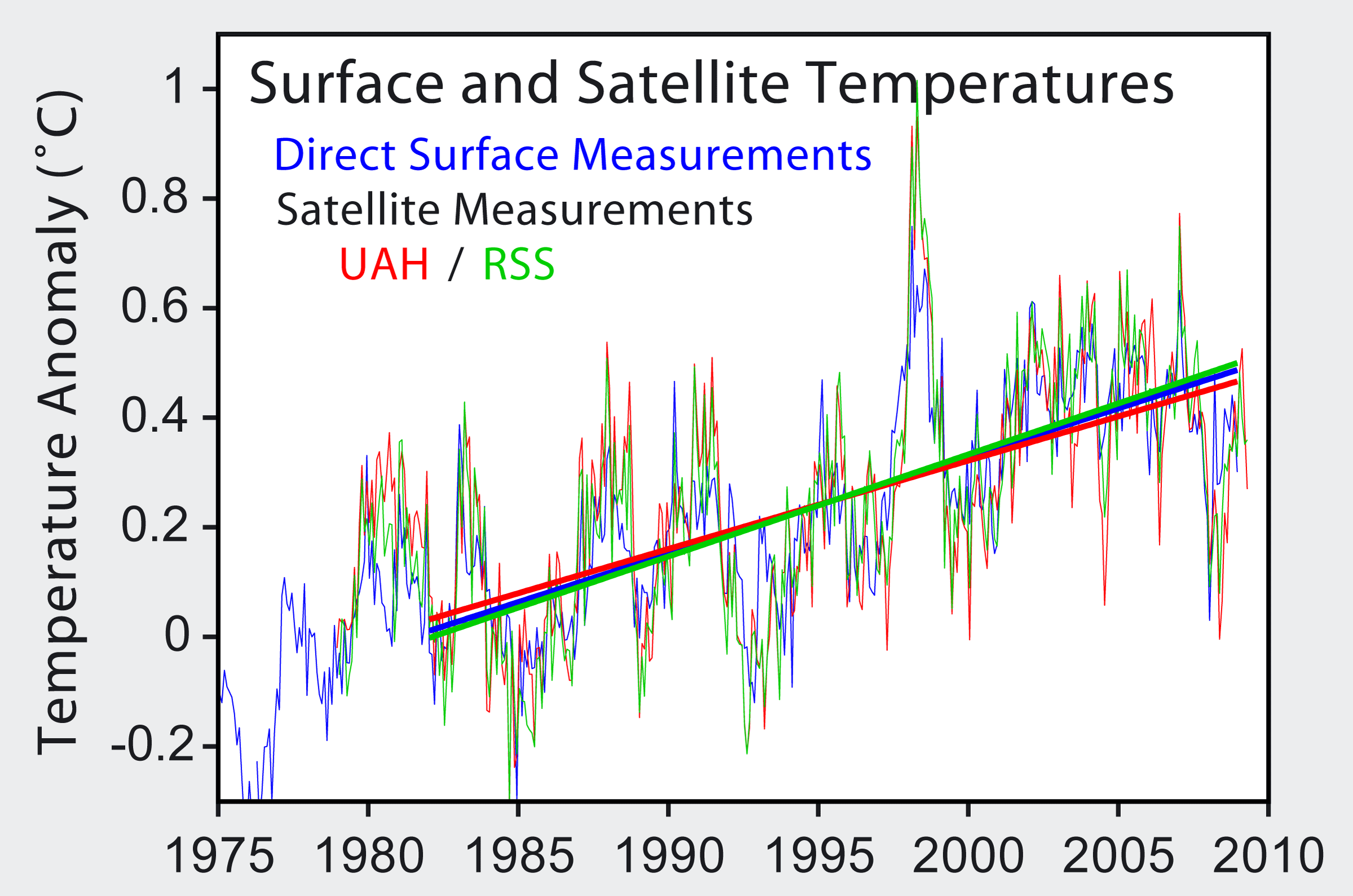
It doesn't work that way, in fact even 2010 being tied for the warmest on record isn't, by itself, important. What is important is the long term trends like the graph to the left which shows over the long term the temperatures have been increasing globally, from Wikipedia. If you go to NASA's climate change website you can see all of the data accumulated thus far showing that climate change is in fact happening. Climate scientists might even actually expect 2011 to be much cooler than 2010 (I don't know that they do this was more just an example), but this will not pronounce climate change dead but will in fact just say that temperatures will vary year to year in the same way that temperature varies day to day. These individual variations are not important again it will always be colder in January than in July in the northern hemisphere and some places will always see snow. What is important is the long term trend, this is what scientists are interested in and this is what they look at. As summarized here, yes I know it is Wikipedia but the summary is good, you can see that of the 20 warmest years the vast majority in the upper half are in the last decade, and here you can see that the last 3 decades have been the warmest decades with each being warmer than the last. That sort of information is important and how climate change is decided not, well it was cold today we should stop worrying.
Global Warming Update: Cooling Trend Continues. March 2011 is on record as the coldest in 15 years. [14]I saw that post and said, "so?" but I realized that many people who read Conservapedia, then again I doubt many people who read Conservapedia read my blog, might not realize that one month being colder isn't important.
The problem with one cold month is that it is only one data point. Global climate change is based on a build up of data that spans decades of research. One or two colder than normal months out of decades do not influence the data to a great degree nor should they be considered proof of the end of climate change, these are what are typically referred to as weather. What Conservapedia and the climate change denialists are doing are cherry picking data. I can do the same thing, as a resident of Lubbock, TX I know last month was hot in fact there was a least one day that we set a new record high. What is more is that the National Weather Service agrees with me and therefore that link that conservapedia posted is completely wrong March was one of the top 15 warmest months on record for the area and therefore their view that global warming is not happening is wrong, and the fact that Texas is in a severe drought means that the whole state is going to run out of water forever (sorry I wanted to find a way to get that link in a post somewhere).
Wednesday, April 6, 2011
Sunday, April 3, 2011
Dr. Prothero on Earthquake Prediction
I have avoided talking about the horrible earthquake in Japan because there are much smarter people than I out there talking much better science than I could. I found one example in this past week's eSkeptic. The article written by Dr. Prothero, a geologist and vertebrate paleontologist at Occidental College in Los Angeles, takes on one of the worst offenders of passing off lies as science.
Among those that got their 15 minutes of fame during the post-quake media blitz was a well-known crank, Jim Berkland, who got a full interview promoting his ideas on Fox News on March 17 (but on no other network). First, the reporter put up a map of the “Ring of Fire” of volcanoes and earthquakes around the Pacific Rim, pointed at Chile, then New Zealand, then Japan, and implied that this circle of quakes might end in California. Apparently, he never consulted a geologist, who would have pointed out that each of those regions is an entirely different type of plate boundary and they have no tectonic plates in common. Then Fox gave Berkland a full five minutes to spout his ideas, with the same credulous reporter tossing him softball questions, and no rebuttal from any other geologist or seismologist.It is a good article and worth going to read the whole thing. I also want to note that Dr. Prothero is now blogging on the skeptic site so go follow him I am sure he will have some great posts in the future.
Monday, March 28, 2011
Another Response to McCarthy
In January I wrote a post about an opinion piece by Jenny McCarthy on the problems with vaccines. In that post I explained how several of the comments that she wrote were wrong on several factual layers. Well on Saturday the James Randi Educational Foundation (JREF) published an article that included some of what I pointed out but also included more as well as more references, and who are we kidding it was much more professional. One of the things I really wanted to point out was something that they said at the end.
As an aside, repeating the words of parents is not how science is done; science uses anecdotes as a starting point to coin hypotheses, and that’s where the relationship ends. Anti-vaxxers cannot have it both ways: either Wakefield was only repeating parent’s words, or he was doing a proper scientific investigation of the parent’s concerns.This is exactly how I feel so make sure you read the article over at JREF.
Next, McCarthy completes the circle: after the incorrect factual statements, and the hint to conspiracy, comes the irate-mom-who-won’t-take-no-for-an-answer act:I know children regress after vaccination because it happened to my own son. Why aren't there any tests out there on the safety of how vaccines are administered in the real world, six at a time? Why have only 2 of the 36 shots our kids receive been looked at for their relationship to autism? Why hasn't anyone ever studied completely non-vaccinated children to understand their autism rate?Please pay special attention to this paragraph. This seems to be the new direction the anti-vaccination movement is moving in, the new position of the goal post. What is so great about this line of thinking however is that it proves what we in the pro-health camp have known for a while: the anti-vaccine proponents know vaccines cause autism. No amount of contradictory evidence will ever be enough, because they will always fantasize something else about vaccines that they can demand to be studied, but that is OK. Our educational efforts are not aimed at the McCarthys, or Meryl Doreys, of the world, but to the parents who are on the fence and about to make a very important decision about their children’s health. We fight for them, and even more importantly for their children, which is why correcting the anti-vaccination misinformation is of paramount importance to the pro-health community
Monday, March 21, 2011
Paleo and the LSEA
The Louisiana Science Education Act was a way to sneak creationist propaganda into public schools in the state of Louisiana. It should come as no surprise that the Society of Vertebrate Paleontology released a statement on that act recently. Head over to the Louisiana Coalition for Science post here for more information.
Subscribe to:
Posts (Atom)