This is an interesting talk, at least to someone who is interested in pterosaurs, by Dr. Michael Habib on how the giant pterosaurs may have been able to launch and fly. And good job by the Royal Tyrrell Museum for posting this talk.
Showing posts with label pterosaur. Show all posts
Showing posts with label pterosaur. Show all posts
Monday, March 12, 2012


Thursday, January 13, 2011
Must See
As someone currently doing research on pterosaurs I find this movie to have a high level of potential. Along with the pterosaurs it stars Sir David Attenborough.
The write up on the official webpage, go here to learn some cool stuff about the pterosaurs themselves as well, says:
The write up on the official webpage, go here to learn some cool stuff about the pterosaurs themselves as well, says:
220 million years ago dinosaurs were beginning their domination of Earth. But another group of reptiles was about to make an extraordinary leap: pterosaurs were taking control of the skies. The story of how and why these mysterious creatures took to the air is more fantastical than any fiction.I hope this comes to the states soon, the next mission would then be to find a near by IMAX
In Flying Monsters 3D, Sir David Attenborough the world’s leading naturalist, sets out to uncover the truth about the enigmatic pterosaurs, whose wingspans of up to 40 feet were equal to that of a modern day jet plane.
The central question and one of the greatest mysteries in palaeontology is: how and why did pterosaurs fly? How did creatures the size of giraffes defy gravity and soar through prehistoric skies?
Driven by the information he finds as he attempts to answer these questions, Attenborough starts to unravel one of science’s more enduring mysteries, discovering that the marvel of pterosaur flight has evolutionary echoes that resonate even today.
Tuesday, November 23, 2010
Pterosaurs Could Fly!
In response to a number of recent papers suggesting that heavy pterosaurs, such as Quetzalcoatlus, might not be able to fly (Chatterjee and Templin, 2004; Wilkinson, 2008; Sato et al., 2009; Henderson, 2010), a new paper was published last week by Dr. Mark Witton and Dr. Michael Habib stating that they could in fact launch themselves and were capable of flight(Witton and Habib, 2010). Most of the media attention focused on the launch part, even though the idea had been published in the past (Habib, 2008), and even some publications that refered to pterosaurs as dinosaurs (argh) I was glad to see the NPR report on the paper that included a few words with Dr. Habib.
Sources
Chatterjee S., and Templin R.J. (2004) Posture, Locomotion and Palaeoecology of Pterosaurs. Geological Society of America Special Publication 376: 1–64.
Habib M.B. (2008) Comparative evidence for quadrupedal launch in pterosaurs.
Zitteliana B28: 161–168.
Henderson D.M. (2010) Pterosaur body mass estimates from three-dimensional
mathematical slicing. Journal of Vertebrate Paleontology 30: 768–785.
Sato K., Sakamoto K., Watanuki Y., Takahashi A., Katsumata N., et al. (2009)
Scaling of soaring seabirds and implications for flight abilities of giant
pterosaurs. PLoS ONE 4: e5400.
Wilkinson M.T. (2008) Three dimensional geometry of a pterosaur wing
skeleton, and its implications for aerial and terrestrial locomotion. Zoological
Journal of Linnaean Society 154: 27–69.
Witton MP, Habib MB (2010) On the Size and Flight Diversity of Giant Pterosaurs, the Use of Birds as Pterosaur Analogues and Comments on Pterosaur Flightlessness. PLoS ONE 5(11): e13982. doi:10.1371/journal.pone.0013982
Sources
Chatterjee S., and Templin R.J. (2004) Posture, Locomotion and Palaeoecology of Pterosaurs. Geological Society of America Special Publication 376: 1–64.
Habib M.B. (2008) Comparative evidence for quadrupedal launch in pterosaurs.
Zitteliana B28: 161–168.
Henderson D.M. (2010) Pterosaur body mass estimates from three-dimensional
mathematical slicing. Journal of Vertebrate Paleontology 30: 768–785.
Sato K., Sakamoto K., Watanuki Y., Takahashi A., Katsumata N., et al. (2009)
Scaling of soaring seabirds and implications for flight abilities of giant
pterosaurs. PLoS ONE 4: e5400.
Wilkinson M.T. (2008) Three dimensional geometry of a pterosaur wing
skeleton, and its implications for aerial and terrestrial locomotion. Zoological
Journal of Linnaean Society 154: 27–69.
Witton MP, Habib MB (2010) On the Size and Flight Diversity of Giant Pterosaurs, the Use of Birds as Pterosaur Analogues and Comments on Pterosaur Flightlessness. PLoS ONE 5(11): e13982. doi:10.1371/journal.pone.0013982
Tuesday, June 8, 2010
Book Review #5
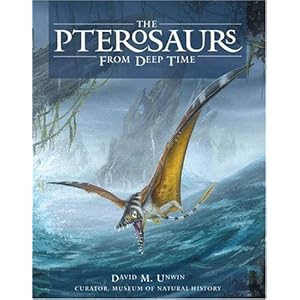 So this review is going to be a little bit different. The prior 4 reviews had been books that I had read purely for enjoyment this meant that the review was based primarily on how much I enjoyed the book. This book was read so I could more easily catch up on the data as far as the current state of affairs in the study of pterosaurs. The book was The Pterosaurs: From Deep Time by Dr. David M. Unwin.
For those of you who haven't figured out what this book is about it is clearly, look at the title, about pterosaurs. These group of flying reptiles is often misunderstood and is understudied for sure. The number of books about the group is very limited and this book, published in 2006, is the first major work on the subject since 1991, The Illustrated Encyclopedia of Pterosaurs by Dr. Peter Wellnhofer which is fairly outdated seriously 15 years is a long time in sciences.
So as always lets see what the cover flap has to say, its long so you can just skip it if you want:
Here is the first complete portrait of the legendary flying dragons of deep time-the pterosaurs-designed for non-specialists, yet founded on real science of these bizarre creatures. Presented lucidly and accessibly by one of the world's leading experts, David Unwin's book is built on a mountain of new fossil discoveries and the latest research.So if you read all that you probably appreciate how long it took me to type all that for those of you who didn't realize it took forever so I understand why you skipped it. Anyway onto the review.
About 220 millions of years ago, a group of reptiles took to Earth's vast and open skies. No longer tethered to the ground, the earliest pterosaurs evolved into a multitude of diverse forms, spread around the globe, and ruled the skies until they went extinct along with the dinosaurs about sixty-five million years ago, rarely leaving fossils as a record of their existence. What they did leave was a mystery for paleontologists to solve; an enigma so difficult to crack that it took centuries of false starts and missteps before the path to a true understanding of pterosaurs was uncovered.
Now, an understanding of the fundamental nature of these strange creatures is finally possible. In the last fifteen years, stunning new fossil finds and significant advances in technology have led to a breakthrough in our knowledge of pterosaurs. New fossils of the earliest species were discovered in Italy, a remarkably well-preserved and complete wing was found in Central Asia, and, most extraordinarily, a pterosaur embryo inside an egg was unearthed in China. CAT scanning has let researchers glimpse inside pterosaur skulls and construct three-dimensional images of their bodies from crushed bones, and modern techniques for analyzing relationships between species have revealed surprising insights into the evolution of the group.
Drawing on these and other advances, David Unwin, caretaker of Archaeopteryx and curator at the Museum of Natural History in Berlin, paints pterosaurs and their world more vividly than has previously been possible. He eloquently reconstructs their biology and behavior. Pterosaurs weren't scaly like dinosaurs, but hairy; most were brightly colored and adorned with remarkable head crests; they were excellent fliers with physiologically sophisticated wings; they walked on all fours; and they varied in size from eight inches to forty feet in wingspan. He shows how they lived their lives, raised their young, and interacted with the different environments of Mesozoic Earth. Then, building on his thorough examination of their anatomy and lifestyle, and using the powerful technique of cladistic analysis, Unwin unravels the evolutionary history of pterosaurs and establishes their place in the one great tree of life.
Packed with seventy color and eighty-five black and white illustrations-including eight full-page original color paintings that are scientific recreations of different pterosaur species-The Pterosaurs From Deep Time takes readers on an wondrous expedition back through the lost world of the Earth's deep past.
The book is wonderfully illustrated with beautiful images and other graphics, although the images in Wellnhofer's are slightly better and well there are more of them. It also presents some of the latest research in pterosaurology, well recent in 2006. The book is written quite simply at times but if you don't have some basic anatomy some of the chapters might get a little complicated. It also provides so huge updates that have occurred in the study of pterosaurs since 1991. The author also includes many inside jokes that a non-expert might not get but I found hilarious like this one from page 226:
Curious, eventful and littered with strange characters-one might expect the pterosaur story to have been told on half a hundred occasions. And so it has been, but often only as part of the backdrop to those hoggers of the limelight: the dinosaurs. When pterosaurs have occasionally made it to the center stage the performance barely lasts on scene. Dimorphodon briefly lurches into view; those trust troupers, Rhamphorhynchus and Pterodactylus, go through their fish-juggling routine; Pteranodon sweeps past, all beak and crest; and Quetzalcoatlus is winched on for the grand finale. Cue volcanoes and meteorites, and there is still time enough to retire to the bar for a quick drink while the King of the Tyrant Lizards eats the final curtain.This book should be a required for all those who want to know anything about pterosaurs. If I have any complaints it is that the book is outdated, imagine how outdated Wellnhofer's is if this one is outdated in 4 years, but that problem should be alleviated later next year, of course after I should be done with my Thesis, with the publication of The Pterosauria (I want this bad!!!). Don't expect this to be an afternoon read it takes a lot of time and with all of his sources referenced you can build quite a large library of pterosaur papers which you might want to reference for a little bit more information when he refers to them. But overall a very informative read that very well summarizes the information on pterosaurs that we have accumulated over the last 200+ years.
Book Citations
UNWIN, D. M. 2006. Pterosaurs from Deep Time. Pi Press, New York, 347 p.
WELLNHOFER, P. 1991. The Illustrated Encyclopedia of Prehistoric Flying Reptiles. Salamander Books Ltd, London, 192 p.
Book review page
Friday, April 30, 2010
Pterosaurs are pterosaurs
Recently a paper was published on a new pterosaur from the Dallas region of Texas (Myers, 2010). While an interesting find, I suggest you find the paper to read about it, I think the paper speaks for itself I wanted to blog about something else. I have read two different public articles about the paper and they both get it wrong.
The first one (found here) is a blog post from Scientific Blogging. Now I have stated in the past that I do enjoy the blogs on Scientific Blogging (see here, here, here, and here) but in this case they said something that made slap my own face.
Come on this is a scientific blog you are supposed to get this right. Lizards fall within the order Squamata and are more specifically within the Suborder of Lacertilia. While they are closely related to lizards, at least more so than they are to mammals, pterosaurs are not lizards. Pterosaurs are an order within the Archosaurs which actually puts them more closely related to crocodiles and dinosaurs than lizards.
So if a scientific blog can't get it right what chance do the nonscientific sources have? This next write up is from Fox News and was sent to me by my father. You don't have to get past the headline to see what is wrong with this article:
Yes they call them dinosaurs and it gets better:
Argh, come on people. While yes both dinosaurs and pterosaurs are members of Ornithodira they differ from there in many ways, not going to go in depth here because it would take to long, and some scientists say they shouldn't even be related this far down. This particular paragraph also makes it seem that pterosaurs, or worse yet dinosaurs, are rare in North America. If you read the actual paper neither one of those statements are what is argued in fact it they are just arguing that the ornithocheirid pterosaurs are rare in North America, in fact this is the second one of that clade found in North America. If they are arguing that dinosaurs are rare in Texas they are also wrong, also see Jacobs (1995).
So what conclusion can we draw from this? Scientists need to make sure that when interviewed we make sure to stress things like pterosaurs are not dinosaurs or lizards. We also need to make sure we do educated the general public when given the chance to point out things like this, because I am sure that most kids could tell you that pterosaurs are not dinosaurs nor are they lizards so we need to make sure we keep stressing this!
Sources
JACOBS, L. 1995. Lone Star Dinosaurs. Texas A& M University Press, College Station, 160 p.
MYERS, T. S. 2010. A new ornithocheirid pterosaur from the upper Cretaceous (Cenomanian-Turonian) Eagle Ford group of Texas. Journal of Vertebrate Paleontology, 30(1):280-287.
The first one (found here) is a blog post from Scientific Blogging. Now I have stated in the past that I do enjoy the blogs on Scientific Blogging (see here, here, here, and here) but in this case they said something that made slap my own face.
The rare pterosaur — literally a winged lizard — is also one of the youngest members in the world of the family Ornithocheiridae, and only the second ornithocheirid ever documented in North America.[emphasis mine]
Come on this is a scientific blog you are supposed to get this right. Lizards fall within the order Squamata and are more specifically within the Suborder of Lacertilia. While they are closely related to lizards, at least more so than they are to mammals, pterosaurs are not lizards. Pterosaurs are an order within the Archosaurs which actually puts them more closely related to crocodiles and dinosaurs than lizards.
So if a scientific blog can't get it right what chance do the nonscientific sources have? This next write up is from Fox News and was sent to me by my father. You don't have to get past the headline to see what is wrong with this article:
New Toothy, Flying Dino Discovered in Texas
Yes they call them dinosaurs and it gets better:
Evidence of these flying creatures has been rare in North America -- the newly identified Aetodactylus halli is only the second such dinosaur ever documented here, although toothed pterosaurs like it were common at the time elsewhere in the world.
Argh, come on people. While yes both dinosaurs and pterosaurs are members of Ornithodira they differ from there in many ways, not going to go in depth here because it would take to long, and some scientists say they shouldn't even be related this far down. This particular paragraph also makes it seem that pterosaurs, or worse yet dinosaurs, are rare in North America. If you read the actual paper neither one of those statements are what is argued in fact it they are just arguing that the ornithocheirid pterosaurs are rare in North America, in fact this is the second one of that clade found in North America. If they are arguing that dinosaurs are rare in Texas they are also wrong, also see Jacobs (1995).
So what conclusion can we draw from this? Scientists need to make sure that when interviewed we make sure to stress things like pterosaurs are not dinosaurs or lizards. We also need to make sure we do educated the general public when given the chance to point out things like this, because I am sure that most kids could tell you that pterosaurs are not dinosaurs nor are they lizards so we need to make sure we keep stressing this!
Sources
JACOBS, L. 1995. Lone Star Dinosaurs. Texas A& M University Press, College Station, 160 p.
MYERS, T. S. 2010. A new ornithocheirid pterosaur from the upper Cretaceous (Cenomanian-Turonian) Eagle Ford group of Texas. Journal of Vertebrate Paleontology, 30(1):280-287.
Subscribe to:
Posts (Atom)