Showing posts with label book review. Show all posts

Friday, September 7, 2012

The Hockey Stick and the Climate Wars: Dispatches from the Front Lines

This summer has been brutal here in the United States. Late in June, Nashville, Tennessee set an all time record high of 109o F (~42.78o C), and while it is a southern city it is normally only in the 90s and humid not 109 and bone dry in Nashville. Nashville wasn't alone June saw over 2000 record high temperatures set throughout the United States. These temperatures along with other climatic conditions created a Derecho which ripped through the east coast. Meanwhile a huge drought in the Western United States provided a tinderbox setting that allowed for the creation of wildfires in Colorado that are their costliest ever. As the summer has continued the drought has only gotten worse, expanding into the bread basket which is posed to make food prices over the next year skyrocket and lowering the Mississippi River to the point that it is making transport of goods on the river difficult. While most of the focus has been on the United States the Arctic also has reached a record low for sea ice extent, and what makes it even worse is this occurred weeks before the normal low. While it is true that no single event can be blamed on climate change it is the addition of all of these events, and the events in past years, that start to build a consensus toward climate change increasing the severity of overall events.

These leads us to a book published earlier this year by Dr. Michael Mann titled, The Hockey Stick and the Climate Wars: Dispatches from the Front Lines. Dr. Mann is the lead author on two of the most important papers in climate science, the papers that show the long term temperature trends and have been termed the hockey stick graphs (so you can see where the title of the book comes from). This book starts while Dr. Mann is still in graduate school and in the beginning shows the point where climate research was in the early 90s. Once Dr. Mann gets involved in climate science the two stories converge and we see how his graph was just one piece in greater puzzle of climate change. Once the scientific consensus is truly established, around 2000, the book switches to a tone of how Dr. Mann had to defend himself from attacks against him, mostly from non-climate scientists, accusing him of doing bad science in the creation of the graph. He shows not only what these arguments were but how the scientific community refutes them and how his graph, with only minor tweaks, still survives to this day. This includes a brief description of the hacked emails from a few years ago and how they don't actually say what people think they say. This tells the tale of Dr. Mann's life and how it has changed since the publication of the hockey stick graph.

This book is, in my opinion, one of the most important books out there. Dr. Mann's telling of the story allows you to see him not as the man who is so often ripped on by climate "skeptics" but as a man who got caught in the middle of something just by doing the science. This is true of many scientists in fields of science where there might be some "controversy", such as climate science and evolution. The main difference is that Dr. Mann didn't ask for it he just ended up in this position because of a question he had been wondering for a while. The way the story is told allows the reader to build on knowledge learned earlier, as a true scientist would, but does not expect the reader to come into the book with all of the back ground. He also backs up his claims, scientific or accusations against him, through a many citations as well as many footnotes making it possible to look up all of his claims. You can see the evidence for climate change growing as the book goes on while the attacks against the graph get weaker and weaker till they seem to be just personal attacks, as prior attacks continue to fail.

One of the problems I do see with the book is the amount it does build on itself. I understand the need for this but citations in the book to see earlier chapters can make a reader get lost if, like me, they had to take several breaks from reading the book that spanned time due to other commitments. I understand the need for this, I am certain that it shortens the book and makes it less repetitive, it just made it hard for me as well. Part of the difficulty as far as this is concerned is that I was reading the Kindle version so flipping back to earlier chapters may wasn't as easy as having the physical book, so take this complaint with a grain of salt. My other problem is just how well cited the book is. I am not saying this is bad in and of itself but as I could click on a link and it would take me to the footnote/citation I wish that the citations had been cited as they would in a scientific paper whereas footnotes would be numbered. It would often lead to me getting a little lost as went back and forth a couple of times reading footnotes and citation. Some of the footnotes were also quite long and could likely have been put in the text itself as they typically only added to the information in the book and didn't really take the story off on long tangents.

Overall this book is a must read, not just for those who understand the science of climate change but for everyone especially those who question the science behind climate change because it will give you the full story and allow you to understand just how strong the science is. As I was finishing the book the Heartland Institute posted billboards with mass murderers touting climate change as happening. While this would end up blowing up in their faces it is important to understand the science so that these false comparisons can be shown for what they are, fear mongering pure and simple!

Book Citation
Mann, Michael E. 2012. The Hockey Stick and the Climate Wars: Dispatches from the Front Lines. Columbia University Press, New York, 384p.

Book review page

Thursday, February 2, 2012

Archaeopteryx: The Icon of Evolution

As with the museum posts(page) it really don't make sense search wise to name my book review posts book review # so I am going to go to naming them the title of the book for simplicities sake. Now on to the review.

It was a typical day in the Late Jurassic (Tithonian to be specific) on a small island located in the Tethys Ocean on what is currently the Bavarian region of Germany. The climate was warm and dry and the sun was beaming down on the small bush sized plants that covered the island. Out over the sea a group of pterosaurs (for me I will say Rhamphorhynchus muensteri) caught fish that swam to close to the surface near the reef while the breath of some of the marine reptiles (e.g. ichthyosaurs) broke the surface on occasion. On shore small theropod dinosaurs poked around in the bushes hoping to find a lizard or insect that they may be able to eat. The young Archaeopteryx had watched this scene play out plenty of times but only recently away from the safety of her mother's nest but at least now she could fly, well at least short distances and her flight wasn't very powerful due to her sternal keel still being cartilage. Her black feathers glistened in the sunlight and as a curious Compsognathus got too close she snapped her toothed jaw at it and flew slightly higher out of grasp for the dinosaur. She of course was a dinosaur too but there was something special about her she also had a lot of features that made her look more bird like than dinosaur like except for her long tail and her toothed "beak", and she certainly wasn't the first dinosaur to look bird-like but she would become when discovered one of the most important. As she looked out over the sea toward the dark black clouds that had been approaching for a while now she realized she was hungry it had been a while since she ate after all. Something hit her on the head and then more and more she wasn't quite sure what this was after all it hadn't rained, at least not much, her entire life. The rain drops also disturbed a dragonfly nearby from the branch it was sitting on and she took off after it. As she closed in a strong gust of wind blew her out over the reef, this was further out to sea than she had ever been. She looked toward shore and then the wind picked up even more. 150 million years later, in 1861, a slab of limestone is split from a quarry in the Solnhofen formation and she would again see the light of a new day but the world would be completely different than the one she lived in but she too would change it greatly.

While that story is clearly fictional the idea behind it is the vast amount of information that we have learned about Archaeopteryx lithographica since the first one was discovered in 1861. While most of this knowledge has been out there for years the first time that I truly saw it all compiled in one place was in a book I just finished called Archaeopteryx: The Icon of Evolution by Dr. Peter Wellnhofer (someone really needs to update and expand on his Wikipedia page). In this book we are taken to Solnhofen where we learn about the limestone that Archaeopteryx was deposited in and how this helps understand the environment that this animal lived in. We then learn about the animal itself and Dr. Wellnhofer tries to fit it into a phylogenetic location which includes a discussion on the different views of how birds evolved as well as the evolution of flight. While there have only been a total of ten (well eleven but the most recent one hasn't been published on yet and was just found late in 2011) body specimens and one isolated feather found we know so much about this animal. Part of the reason is how complete the specimens are with most being nearly complete but what I think the main reason for the amount we know about the animal is the just sheer amount of research that has been done on the specimens since it was the first animal found that truly showed the evolution of organisms in action, in this case the evolution of dinosaurs to birds.

This book is exceptionally well written and that is due to the sheer amount of knowledge that Dr. Wellnhofer has on paleontology and in particular the Solnhofen region. If you want to learn about Archaeopteryx or if you want to learn about Solnhofen geology or if you just want a book with really really nice pictures of really amazing fossils this is the book for you. Detailed images of all 10 of the specimens are included including pictures taken using infrared which really helps show off a lot of the soft tissue preserved in the specimen. There is a detailed description of the genus in general as well as where it fits evolutionarily which includes a very through description of the origin of birds including the many hypothesis of what the evolved from, and he, logically, leans toward them evolving from theropod dinosaurs. There is also a brief overview of the different ideas of how flight and feathers evolved and a basic overview of known, as of 2009, Mesozoic bird species.

If there is one fault in the book it is that it is too detailed. At times I felt like I was dredging through scientific papers, this is part of the reason it took me so long to finish, so if you aren't an expert in the field or haven't spent a lot of time reading scientific papers on dinosaur and bird evolution you might struggle a bit through parts. Most of the book is easily readable and the parts that are technical can be skipped or skimmed over without missing the overall point or theme of the section so don't let the technical nature scare you off. The price might scare you off but it is worth it for all the knowledge contained within.

The only other problem is that the book is dated which should say something about how fast the science has come since 2009. This is really that much of a problem after all how was Dr. Wellnhofer supposed to know that since I started reading the book early last year that phylogenetic studies would say that Archaeopteryx is not a bird (Naish et al., 2011; Xu et al. 2011), although at least one study disagrees (Lee & Worthy, 2011), that the color of the feathers would be determined (Carney et al., 2012), and that an even earlier feathered dinosaur would be discovered (Liu et al., 2012) (I got the e-mail about that last one as I was working on this review). So I will forgive the book seemingly being slightly dated since there are so many new specimens found in the paleontology world every year, there have been several new Mesozoic birds found in the past year (e.g. Xu et al., 2011).

This book is very interesting and worth picking up. It is a handy reference for the currently known specimens as well as about the evolution of birds in general. Oh and did I mention it has very awesome pictures, yeah they are very pretty. I will leave you, again, with a picture of the one specimen of Archaeopteryx that I have seen, the Thermopolis specimen, it was a great experience.


Book citation
Wellnhofer, P. 2009. Archaeopteryx: The Icon of Evolution. Verlag Dr. Friedrich Pfeil, Munchen, 208p.

References
Lee, M. S. Y., & T. H. Worthy. 2011. Likelihood reinstates Archaeopteryx as a primitive bird. Biology Letters doi: 10.1098/rsbl.2011.0884.

Liu, Y.-Q., Kuang, H.-W., Jiang, X.-J., Peng, N., Xu, H., & Sun, H.-Y. 2012. Timing of the earliest known feathered dinosaurs and transitional pterosaurs older than the Jehol Biota. Palaeogeography, Palaeoclimatology, Palaeoecology doi: 10.1016/j.palaeo.2012.01.017.

Naish, D., Dyke, G., Cau, A., Escuillié, F. & Godefroit, P. 2011. A gigantic bird from the Upper Cretaceous of Central Asia. Biology Letters doi: 10.1098/rsbl.2011.0683 (I should note that there is some doubt if this is actually a bird anymore but that shouldn't change the phylogentic tree published within)

Xu, X., You, H., Du, K. & Han, F. 2011. An Archaeopteryx-like theropod from China and the origin of Avialae. Nature 475, 465-470.

Book review page

Sunday, February 27, 2011

Book Review #6

Have I really not done a book review since June 8th, wow! I guess that is what happens when you stop reading books and spend most of your time reading scientific papers. Oh well on to the review.

In 1859 when Charles Darwin first published The Origin of Species by Means of Natural Selection he knew that the keys to his theory would lie in the fossil record. In 1861 a fossil would be found that would lend huge credence to his evolutionary theory. This fossil would eventually be named Archaeopteryx lithographica, the name was originally just given to a feather but I will let this post flush out that problem, and would be come one of the most famous fossils in history. The fossil was found in rocks in the Bavarian region of southern Germany in a formation named after a small town known as Solnhofen. Since then the Solnhofen Formation (or Plattenkalk) is one of the most well known formations in the world famous for Archaeopteryx as well as several genera of pterosaur.

The formation has probably been known about for as long as humans have been in the region for its ability to split into thin sheets that are perfect for roofing [Image below and right is of a specimen of a Coelacanth Coccoderma nudum from the Solnhofen limeston by author at the Houston Musuem of Natural Science by author]. The Roman buildings in the region often incorporate pieces of the formation. Being a limestone, which dissolves easily in acid, it was eventually discovered that it could be used to make lithographic plates for art. During this time fossils had to have been discovered and eventually during the 1700s when science started to take off they were finally noticed. Fossils from the formation have now been scattered around the globe as they preserve beautifully the soft tissue of many of the organisms that lived in the region. The problem is that even though the area has been well known for a long time there has been very little published in English for an English speaking audience. That changed with the publication in 1990 of Solnhofen: A Study in Mesozoic Palaeontology by K.W. Barthel, N.H.M. Swinburne, and S. Conway Morris (Amazon page). This book will be the focus of this review, lets read the back cover.
The celebrated Solnhofen Limestone is among the most important fossil deposits because of its astonishing diversity of organisms, many exquisitely preserved. Marine and terrestrial creatures and plants, buried 150 million years ago in soft lagoonal muds, provide a unique glimpse into the true diversity of Jurassic life. Articulated skeletons are preserved, as well as some soft-bodied animals that otherwise would be too delicate to survive fossilisation. Among the highlights are superbly preserved jellyfish, crustaceans, squid, fish and flying reptiles. Perhaps most important of all is Archaeopteryx - the celebrated 'missing link' which has the skeleton of a dinosaur but is covered in feathers, revealing a crucial evolutionary transition between the reptiles and the birds. Solnhofen opens a window into a vanished world, and reveals the unexpected richness of a land and sea teeming with life.

This book is a revised and updated translation of Werner Barthel's classic work Solnhofen: Ein Blick in die Erdgeschichte. In revising the text, Nicola Swinburne and Simon Conway Morris have added a considerable amount of new material whilst preserving the spirit of the original book. This is an authoritative account of the geological history, palaeoecology, palaeoenvironment and fossil taxonomy of this classic location. Not only will it be of great interest to palaeontologists and evolutionary biologists, but it will also be of value to amateur collectors, natural historians and also those with an interest in the history of life.
Overall I would say this book is an interesting read. I first started this book over a year ago when I was trying to figure out the basic geologic background to the area and I was struggling to find much published on the area in English. The geologic background in this book gave me a good starting point so I could find other English sources and eventually understand where the current state of understanding of the formation is. It does a really good job of this but if you don't have much of a geologic background you may want/need to study up before you get there. All of the sources are cited but it gets a little technical at times. I recently figured I should finish reading it, aka today I have been referring back to the geologic setting portions a lot recently, and finished off the summary of the fossil organisms present. This was interesting because without mentioning phylogenetics the majority of the organisms are organized phylogenetically, except for the last three on dinosaurs, pterosaurs, and birds.

My only real complaint about this book, and one everyone trying to understand the geology of the region needs to understand, is that it is dated. This isn't bad considering it was published in 1990 and much of the geologic setting is the same but there are some minor changes that have occurred in the 20 years, wow really, since this was published. This includes the discovery of an additional four specimens of Archaeopteryx. If you want the most up to date geologic data in an easy to read book pick up Dr. Peter Wellnhofer's Archaeopteryx: The Icon of Evolution (Amazon page), I haven't read the whole thing yet (read: should be the next book review) but the geologic setting is up to date and easy to read.

Overall this book is easy to read and gives good background information on the formation and surrounding areas. It is a little dated so if this is your first foray into the geology of the area make sure you find some of the newer papers and catch up but this is a good starting point. If you do not have much of a geologic background it shouldn't be too hard to catch up but you will most likely need to do so before you get too far into the book or you will get left in the dust. I will end this post with an image I took of a the Thermopolis specimen of Archaeopteryx when it was on display at the Houston Museum of Natural Science (see post on this trip here).

Book Citation

BARTHEL, K. W., N. H. M. SWINBURNE, AND S. C. MORRIS. 1990. Solnhofen: A study in Mesozoic palaeontology. Cambridge University Press, Cambridge, ix, 236 p.

Book review page

Tuesday, June 8, 2010

Book Review #5

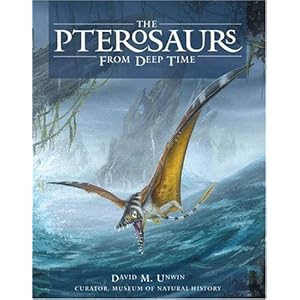
So this review is going to be a little bit different. The prior 4 reviews had been books that I had read purely for enjoyment this meant that the review was based primarily on how much I enjoyed the book. This book was read so I could more easily catch up on the data as far as the current state of affairs in the study of pterosaurs. The book was The Pterosaurs: From Deep Time by Dr. David M. Unwin.

For those of you who haven't figured out what this book is about it is clearly, look at the title, about pterosaurs. These group of flying reptiles is often misunderstood and is understudied for sure. The number of books about the group is very limited and this book, published in 2006, is the first major work on the subject since 1991, The Illustrated Encyclopedia of Pterosaurs by Dr. Peter Wellnhofer which is fairly outdated seriously 15 years is a long time in sciences.

So as always lets see what the cover flap has to say, its long so you can just skip it if you want:
Here is the first complete portrait of the legendary flying dragons of deep time-the pterosaurs-designed for non-specialists, yet founded on real science of these bizarre creatures. Presented lucidly and accessibly by one of the world's leading experts, David Unwin's book is built on a mountain of new fossil discoveries and the latest research.

About 220 millions of years ago, a group of reptiles took to Earth's vast and open skies. No longer tethered to the ground, the earliest pterosaurs evolved into a multitude of diverse forms, spread around the globe, and ruled the skies until they went extinct along with the dinosaurs about sixty-five million years ago, rarely leaving fossils as a record of their existence. What they did leave was a mystery for paleontologists to solve; an enigma so difficult to crack that it took centuries of false starts and missteps before the path to a true understanding of pterosaurs was uncovered.

Now, an understanding of the fundamental nature of these strange creatures is finally possible. In the last fifteen years, stunning new fossil finds and significant advances in technology have led to a breakthrough in our knowledge of pterosaurs. New fossils of the earliest species were discovered in Italy, a remarkably well-preserved and complete wing was found in Central Asia, and, most extraordinarily, a pterosaur embryo inside an egg was unearthed in China. CAT scanning has let researchers glimpse inside pterosaur skulls and construct three-dimensional images of their bodies from crushed bones, and modern techniques for analyzing relationships between species have revealed surprising insights into the evolution of the group.

Drawing on these and other advances, David Unwin, caretaker of Archaeopteryx and curator at the Museum of Natural History in Berlin, paints pterosaurs and their world more vividly than has previously been possible. He eloquently reconstructs their biology and behavior. Pterosaurs weren't scaly like dinosaurs, but hairy; most were brightly colored and adorned with remarkable head crests; they were excellent fliers with physiologically sophisticated wings; they walked on all fours; and they varied in size from eight inches to forty feet in wingspan. He shows how they lived their lives, raised their young, and interacted with the different environments of Mesozoic Earth. Then, building on his thorough examination of their anatomy and lifestyle, and using the powerful technique of cladistic analysis, Unwin unravels the evolutionary history of pterosaurs and establishes their place in the one great tree of life.

Packed with seventy color and eighty-five black and white illustrations-including eight full-page original color paintings that are scientific recreations of different pterosaur species-The Pterosaurs From Deep Time takes readers on an wondrous expedition back through the lost world of the Earth's deep past.
So if you read all that you probably appreciate how long it took me to type all that for those of you who didn't realize it took forever so I understand why you skipped it. Anyway onto the review.

The book is wonderfully illustrated with beautiful images and other graphics, although the images in Wellnhofer's are slightly better and well there are more of them. It also presents some of the latest research in pterosaurology, well recent in 2006. The book is written quite simply at times but if you don't have some basic anatomy some of the chapters might get a little complicated. It also provides so huge updates that have occurred in the study of pterosaurs since 1991. The author also includes many inside jokes that a non-expert might not get but I found hilarious like this one from page 226:
Curious, eventful and littered with strange characters-one might expect the pterosaur story to have been told on half a hundred occasions. And so it has been, but often only as part of the backdrop to those hoggers of the limelight: the dinosaurs. When pterosaurs have occasionally made it to the center stage the performance barely lasts on scene. Dimorphodon briefly lurches into view; those trust troupers, Rhamphorhynchus and Pterodactylus, go through their fish-juggling routine; Pteranodon sweeps past, all beak and crest; and Quetzalcoatlus is winched on for the grand finale. Cue volcanoes and meteorites, and there is still time enough to retire to the bar for a quick drink while the King of the Tyrant Lizards eats the final curtain.
This book should be a required for all those who want to know anything about pterosaurs. If I have any complaints it is that the book is outdated, imagine how outdated Wellnhofer's is if this one is outdated in 4 years, but that problem should be alleviated later next year, of course after I should be done with my Thesis, with the publication of The Pterosauria (I want this bad!!!). Don't expect this to be an afternoon read it takes a lot of time and with all of his sources referenced you can build quite a large library of pterosaur papers which you might want to reference for a little bit more information when he refers to them. But overall a very informative read that very well summarizes the information on pterosaurs that we have accumulated over the last 200+ years.

Book Citations
UNWIN, D. M. 2006. Pterosaurs from Deep Time. Pi Press, New York, 347 p.

WELLNHOFER, P. 1991. The Illustrated Encyclopedia of Prehistoric Flying Reptiles. Salamander Books Ltd, London, 192 p.

Book review page

Thursday, May 6, 2010

Book Review #4

I have been working on this book for probably about 6 months now and finally decided that if I was ever going to finish another book I wanted to read it was going to have to be by reading a chapter or so a night right before I go to bed. The book that I read for this review was Why Darwin Matters by Dr. Michael Shermer.

This book is very much a dismantling of the intelligent design community saying that what they practice is science, the fact that the subtitle is "The case against Intelligent Design" should have been a dead give away for that. While many people have written books about it (see Only a Theory here). Dr Shermer takes on ID by not just showing what they believe is a religion and how all of their main claims are wrong, but he also shows how evolution is the correct theory. The back cover reads:

In Why Darwin Matters, Michael Shermer, the bestselling author of Why People Believe Weird Things and the publisher of Skeptic magazine, decodes the facts of evolution and shows how natural selection achieves the elegant design of life. Shermer, once an evangelical Christian and a creationist, argues that Intelligent Design proponents invoke a combination of bad, science, political antipathy, and flawed theology in their new brand of creationism. He refutes their pseudoscientific arguments and then demonstrates why conservatives and people of faith can and should embrace evolution. Why Darwin Matters is an incisive examination of what is at stake in the debate over evolution.


I really did enjoy this book it was an easy read and when I set myself too it I got through it very quickly. The data he presents is well supported and he handles the situation including the victory in Dover very humbly. He also shows why those who present themselves as Christians and Conservatives should really accept evolution. The book tends to strive away from the technical and lays out the case in a way everyone should be able to understand it.

Dr. Shermer is a very strong Atheist but it did not come off in this book. In fact if you were just a casual reader you might even be inclined to think that he is a Christian, although this might come from his devout Christian up bringing. I would recommend this book to anyone who might be questioning evolution, I only limit because those devoutly religious who already outright deny evolution probably won't read this at all. Read it see why science is important, the real questions in evolutionary theory currently (and how they are being solved), and how science and religion tackle very separate questions.

Book Citation
Shermer, Michael. Why Darwin Matters: The Case Against Intelligent Design. 2006. Holt: New York

Book review page

Wednesday, December 23, 2009

Book Review #3

I finally have had some time to read. And while this is a good thing it turns out that I did not bring near enough books home to read. It is kind of sad that a book that I started months ago I read in 3 days, although I only actually read 2 of those days, and the main reason I got done so fast was that I had to wait for 3 and 1/2 hours for my car to get inspected.

But enough about me lets get to talking about the book. This book is a book I promised would be in my second book review when I wrote my first one (1st one here, 2nd one here) and that I failed miserably at. Yes I finally finished Your Inner Fish by Dr. Neil Shubin. In this book Dr. Shubin uses his discovery of Tiktaalik to describe in very simple terms the evolution of humans from simple single celled organisms to what we are now. In the process he talks about the major skull systems like sight, hearing, and smell and describes how they evolved from our more simple relatives to now. The description on the book reads:

WHY DO WE LOOK THE WAY WE DO? Neil Shubin, the paleontologist and professor of anatomy who co-discovered Tiktaalik, the "fish with hands," tells the story of our bodies as you've never heard it before. By examining fossils and DNA, he shows us that our hands actually resemble fish fins, our heads are organized like long-extinct jawless fish, and the major parts of our genome look, and function, like those of worms and bacteria. Your Inner Fish makes us look at ourselves and our world in an illuminating new light. This is science writing at its finest--enlightening, accessible, and told with irresistible enthusiasm.


I really did love this book. It is a very simple read, at least for someone who just took a class in vertebrate paleontology in which a lot of the same topics where discussed, so it doesn't like some one is lecturing too you but at the same time it is not so simple that you feel that someone should be cleaning drool off of your chin. It is clearly written for someone with at least some education that somewhere along the line included some basic biology. He also includes within a couple of quick one-liners that actually had me laughing as I read them. I like the way he treats the subject as well he takes you through his life at the start of each chapter and you can feel him "evolving" as a human and each of his stories in someway tie into the topic of that chapter.

If there was one thing he could have done better is to disguise the book. What do I mean by that? Well the full title of the book is Your Inner Fish, A Journey into the 3.5 Billion-year History of the Human Body. Right away any creationist is not going to pick this book up to read it. And the sad thing is that those are the people who need to read this book the most. He is very clear in how evolution works and would clear up a lot of misconceptions that creationists have about the science involved. So what should he have done? I don't really know the answer to that maybe come up with a name like "How Tiktaalik disproves evolution" and then have "not" written somewhere really small on the cover.

So what do I suggest? I recommend that you read this book it is a very good intro to evolution and if you are a high school or college student interested in evolution at all you should definitely read it. But after you read it you should make sure that your creationist friends read it, I would say go make them buy another copy but then I doubt they would do that since well I have a hard time buying creationist books, they are the ones after all who really do need it.

The author has a website (here) which has a lot of supplementary material for the book, and in fact as I found out from Dr. PZ Myers' blog (Pharyngula found here) today Dr. Shubin and company put out all of the images from the book on PowerPoint slides for teachers to use during their lectures (here). Dr. Shubin they have been downloaded and will be greatly appreciated during my lab teaching in the spring semester but will obviously be referenced to you I thank you.

Book citation
Neil Shubin . Your Inner Fish, a Journey into the 3.5-Billion-Year History of the Human Body. 2008. Pantheon Books. New York.

Book review page

Friday, September 11, 2009

Book Review #2

Alright so I know I promised more book reviews earlier on but life got in the way and now school is starting to again as well but I finally finished another book. This time the book is Dinosaurs of the East Coast by David B. Weishampel and Luther Young, I know I promised to review Your Inner Fish next but this one seems smaller and like it would be a quick read before I started. But anyway before I get to the review here is what the cover says:
"The great dinosaur bone beds of the American and Canadian West are world famous and have yielded spectacular fossil finds. But the eastern United States and maritime Canada, where dinosaurs also roamed in great numbers, have been equally important to the study of these extraordinary creatures.

In Dinosaurs of the East Coast David Weishampel and Luther Young restore East Coast dinosaursto their rightful place on the paleontological map. They describe such dinosaurs as the plant-eating Astrodon johnstoni, similar to the Brachiosaurs, which browsed in the tropical Maryland jungle 100 million years ago. Other East Coast dinosaurs included a distant relative of Astrodon, Anchisaurus polyzelus, which lived in New England some 200 million years ago. And the remains of Hadrosaurus foulkii, a duck-billed dinosaur that lived in New Jersey some 70 million years ago, represented North America's first well-preserved dinosaur skeleton.

The authors also show that dinosaur fossil-hunting has not only had a long history along the Atlantic coast but also is very much alive there today. Some dinosaur fossils have come from the bog iron and clay pits of Maryland and New Jersey, while others have been discovered in the riverbanks of North and South Carolina. Dinosaur footprint sites have been found from central Virginia to the Bay of Fundy in Nova Scotia.

Richly illustrated with more than one hundred photographs and drawings, Dinosaurs of the East Coast combines science, history, and modern reporting to offer a new look at an always fascinating subject.
Alright on to my review.

Overall I thought this book was an interesting read. But I will say this is not beach reading there is a lot of scientific data and information but it is presented in such a way that anyone who has at least some high school education should be able to understand it. If you have studied a lot about dinosaurs you may not be interested in about half the book which deals with the basics of dinosaur types, and evolution, and the controversies currently being studied in dinosaur paleontology. Another problem I had was that the book seems to spend a lot of time focusing on western dinosaurs for a book about eastern dinosaurs.

If it is your first time sitting down and reading about dinosaurs you should find all of the introductory information very helpful. It is also nice that they refer back multiple times to the chapter in which they talk about something for the first time so if you forget what they are talking about you just have to refer back, trust me I had to do this a couple of times. I learned a lot of information that I did not know or did not remember about east coast dinosaurs. I did not know about all of the sites that they talk about and they smartly do not give away specific locations. There are plenty of pictures especially of the people who are currently doing the research.

All in all this is a well written introduction to east coast dinosaurs, with all their sources cited if you want more information, that plays a great homage to the people who have done the research, are doing the research now, or will do it in the future. While this is not a book for everyone, I recommend this to anyone living on the east coast who has any interest in dinosaurs or to anyone who has any interest in dinosaurs in general.

Book Citation:
Weishampel, David B. and Luther Young. Dinosaurs of the East Coast. Baltimore: The Johns Hopkins University Press, 1996.

Book review page

Thursday, May 7, 2009

Book Review #1

Alright so I have decided to do these randomly from now on, aka whenever I finish a book that I feel needs me to have a statement made about it and since this is my first time doing this and I have actually read 3 books recently that are worth mentioning I will do all 3 but they will be short and to the point.


Fahrenheit 451 by Ray Bradbury


Now this is a classic that I assume that most of us have read in middle or high school, well my school we read a handful of pages from it. Back then I thought it was good but when you are assigned a book you never read it, it is when you want to read it that you actually do. I actually had this book given to me so I figured what the heck, sorry there is a lot of rambling here let me move on. This is a book that everyone MUST read at some point in time. As I read it I got chills, something that I may not have gotten in high school. This book seems to be very right on with the way civilization is headed and if you have read the book you will understand why that is scary! But again this is a MUST read by everyone be you American, European, or even Martian read this.


Only a Theory by Dr. Kenneth Miller

For anyone who thinks there might be some hope of the ID movement taking over Dr. Miller puts most of those fears to rest. He explains how we got to here with ID but he also refutes their "downfalls" in evolution, and finally explains why we MUST teach evolution and science to students today. This is a good read for anyone who has ever, or will ever, debate a proponent of ID. It will also help you realize that they bring nothing constructive to the table and are in the long run just a bunch of crazies(my wording not his).


Tyrannosaur Canyon by Douglas Preston


Another book that I was given as a gift from a friend, notice a trend here. This book is very good fictional read. It reads a lot like most of Michael Crichton's books but instead of dealing with science gone awry it deals with just crazy people. One of the reviewers, Stephen Coonts, said, "If John Grisham had written Jurassic Park, he couldn't do better than Tyrannosaur Canyon." I don't know if I would compare it completely to Jurassic Park but it is a very good read and anyone interested in murder, conspiracy, and Paleontology will love this book, at least in my opinion.


The next book that I will be on the lookout for will be Your Inner Fish I have seen it cheap online in softcover but the next few weeks will see me bouncing around the country, well mostly the East including a stop at SEAVP (I will not be presenting), so I don't want to get it and have it delivered somewhere and have it sit there for a long time. Anyway as always I welcome any questions, comments, concerns, and/or suggestions.
Edit:
Ok so I was able to buy Your Inner Fish today so once I get some time to read it I will put up my thoughts on here.


Book review page