Showing posts with label Dinosaur. Show all posts

Thursday, February 2, 2012

Archaeopteryx: The Icon of Evolution

As with the museum posts(page) it really don't make sense search wise to name my book review posts book review # so I am going to go to naming them the title of the book for simplicities sake. Now on to the review.

It was a typical day in the Late Jurassic (Tithonian to be specific) on a small island located in the Tethys Ocean on what is currently the Bavarian region of Germany. The climate was warm and dry and the sun was beaming down on the small bush sized plants that covered the island. Out over the sea a group of pterosaurs (for me I will say Rhamphorhynchus muensteri) caught fish that swam to close to the surface near the reef while the breath of some of the marine reptiles (e.g. ichthyosaurs) broke the surface on occasion. On shore small theropod dinosaurs poked around in the bushes hoping to find a lizard or insect that they may be able to eat. The young Archaeopteryx had watched this scene play out plenty of times but only recently away from the safety of her mother's nest but at least now she could fly, well at least short distances and her flight wasn't very powerful due to her sternal keel still being cartilage. Her black feathers glistened in the sunlight and as a curious Compsognathus got too close she snapped her toothed jaw at it and flew slightly higher out of grasp for the dinosaur. She of course was a dinosaur too but there was something special about her she also had a lot of features that made her look more bird like than dinosaur like except for her long tail and her toothed "beak", and she certainly wasn't the first dinosaur to look bird-like but she would become when discovered one of the most important. As she looked out over the sea toward the dark black clouds that had been approaching for a while now she realized she was hungry it had been a while since she ate after all. Something hit her on the head and then more and more she wasn't quite sure what this was after all it hadn't rained, at least not much, her entire life. The rain drops also disturbed a dragonfly nearby from the branch it was sitting on and she took off after it. As she closed in a strong gust of wind blew her out over the reef, this was further out to sea than she had ever been. She looked toward shore and then the wind picked up even more. 150 million years later, in 1861, a slab of limestone is split from a quarry in the Solnhofen formation and she would again see the light of a new day but the world would be completely different than the one she lived in but she too would change it greatly.

While that story is clearly fictional the idea behind it is the vast amount of information that we have learned about Archaeopteryx lithographica since the first one was discovered in 1861. While most of this knowledge has been out there for years the first time that I truly saw it all compiled in one place was in a book I just finished called Archaeopteryx: The Icon of Evolution by Dr. Peter Wellnhofer (someone really needs to update and expand on his Wikipedia page). In this book we are taken to Solnhofen where we learn about the limestone that Archaeopteryx was deposited in and how this helps understand the environment that this animal lived in. We then learn about the animal itself and Dr. Wellnhofer tries to fit it into a phylogenetic location which includes a discussion on the different views of how birds evolved as well as the evolution of flight. While there have only been a total of ten (well eleven but the most recent one hasn't been published on yet and was just found late in 2011) body specimens and one isolated feather found we know so much about this animal. Part of the reason is how complete the specimens are with most being nearly complete but what I think the main reason for the amount we know about the animal is the just sheer amount of research that has been done on the specimens since it was the first animal found that truly showed the evolution of organisms in action, in this case the evolution of dinosaurs to birds.

This book is exceptionally well written and that is due to the sheer amount of knowledge that Dr. Wellnhofer has on paleontology and in particular the Solnhofen region. If you want to learn about Archaeopteryx or if you want to learn about Solnhofen geology or if you just want a book with really really nice pictures of really amazing fossils this is the book for you. Detailed images of all 10 of the specimens are included including pictures taken using infrared which really helps show off a lot of the soft tissue preserved in the specimen. There is a detailed description of the genus in general as well as where it fits evolutionarily which includes a very through description of the origin of birds including the many hypothesis of what the evolved from, and he, logically, leans toward them evolving from theropod dinosaurs. There is also a brief overview of the different ideas of how flight and feathers evolved and a basic overview of known, as of 2009, Mesozoic bird species.

If there is one fault in the book it is that it is too detailed. At times I felt like I was dredging through scientific papers, this is part of the reason it took me so long to finish, so if you aren't an expert in the field or haven't spent a lot of time reading scientific papers on dinosaur and bird evolution you might struggle a bit through parts. Most of the book is easily readable and the parts that are technical can be skipped or skimmed over without missing the overall point or theme of the section so don't let the technical nature scare you off. The price might scare you off but it is worth it for all the knowledge contained within.

The only other problem is that the book is dated which should say something about how fast the science has come since 2009. This is really that much of a problem after all how was Dr. Wellnhofer supposed to know that since I started reading the book early last year that phylogenetic studies would say that Archaeopteryx is not a bird (Naish et al., 2011; Xu et al. 2011), although at least one study disagrees (Lee & Worthy, 2011), that the color of the feathers would be determined (Carney et al., 2012), and that an even earlier feathered dinosaur would be discovered (Liu et al., 2012) (I got the e-mail about that last one as I was working on this review). So I will forgive the book seemingly being slightly dated since there are so many new specimens found in the paleontology world every year, there have been several new Mesozoic birds found in the past year (e.g. Xu et al., 2011).

This book is very interesting and worth picking up. It is a handy reference for the currently known specimens as well as about the evolution of birds in general. Oh and did I mention it has very awesome pictures, yeah they are very pretty. I will leave you, again, with a picture of the one specimen of Archaeopteryx that I have seen, the Thermopolis specimen, it was a great experience.


Book citation
Wellnhofer, P. 2009. Archaeopteryx: The Icon of Evolution. Verlag Dr. Friedrich Pfeil, Munchen, 208p.

References
Lee, M. S. Y., & T. H. Worthy. 2011. Likelihood reinstates Archaeopteryx as a primitive bird. Biology Letters doi: 10.1098/rsbl.2011.0884.

Liu, Y.-Q., Kuang, H.-W., Jiang, X.-J., Peng, N., Xu, H., & Sun, H.-Y. 2012. Timing of the earliest known feathered dinosaurs and transitional pterosaurs older than the Jehol Biota. Palaeogeography, Palaeoclimatology, Palaeoecology doi: 10.1016/j.palaeo.2012.01.017.

Naish, D., Dyke, G., Cau, A., Escuillié, F. & Godefroit, P. 2011. A gigantic bird from the Upper Cretaceous of Central Asia. Biology Letters doi: 10.1098/rsbl.2011.0683 (I should note that there is some doubt if this is actually a bird anymore but that shouldn't change the phylogentic tree published within)

Xu, X., You, H., Du, K. & Han, F. 2011. An Archaeopteryx-like theropod from China and the origin of Avialae. Nature 475, 465-470.

Book review page

Monday, November 14, 2011

Evolution and Thanksgiving

SMBC is at it again this time combining evolution with thanksgiving also dinosaurs because who doesn't love dinosaurs. Yes I know this was posted on their site almost a week ago but I have been busy.


Friday, September 30, 2011

Happy 150th Birthday Archaeopteryx

I was hoping to have the book Archaeopteryx: Icon of Evolution by Peter Wellnhofer finished by today but as life has gotten in the way I have not been able to do that, hmm maybe I should read not that I am feeling inspired...

150 years ago today (today being 30 September 2011 and 150 years ago being 30 September 1861) an article was published by Hermann von Meyer which while only being 2 paragraphs long the first of which said this [German from the H. v. Meyer (1861) and English translation from Wellnhofer (2009)]
Nachtrüglich zu meinem Schreiben vom 15 verflossenen Monats Kann ich Ihuen nunmehr mittheilen, dass ich die Feder von Solenhofen nach allen Richtungen hin genau untersucht habe und dabei zu dem Ergebniss gekommen bin, dass sie eine wirklich Versteinerung des lithographischen Schiefers ist und vollkommen mit einer Vogel-Feder übereinstimmt. Zugleich erhalte ich von Herrn Obergerichtsrath Witte die Nachricht, dass das fast vollständige Skelet eines mit Federn bedeckten Thiers im lithographischen Schiefer gefunden worden sey. Von unseren lebenden Vögeln zeige es manche Abweichung. Die von mir untersuchie Feder werde ich mit genauer Abbildung veröffentlichen. Zur Bezeichnung des Thieres halte ich die Benennung Archaeopteryx lithographica geeignet.
[In addition to my letter of the 15th of last month I can now report that I have carefully studied the feather in all respects with the result that it is a real fossil from the lithographic shale and perfectly agrees with a bird's feather. Coincidentally I received a message from the "Obergerichtsrath" Witte that an almost complete skeleton of an animal covered with feathers was found in the lithographic shale. It showed several differences from living birds. The feather I had studied will be published along with a detailed description. For the name of the animal I consider Archaeopteryx lithographica as suitable.](emphasis mine)
Obviously there has been some confusion if the feather should be the type specimen or the fossil of the whole animal, which would eventually become the London Specimen, but the ICZN has clarified it as the animal is the type specimen so no worries anymore.

Archaeopteryx is an amazing find and even if it isn't a true bird it represents more than that. The specimens showed transitions between animals it has the feathers and many of the body parts of a bird but they are not completely bird like, it also has long claws and the teeth of the dinosaurs. This showed that dinosaurs and birds were related and while Darwin never used it as an icon for evolution it truly is one. 150 years ago paleontology was still young and we were still trying to understand what we were looking at to find an animal with feathers and dinosaur traits then was amazing and never heard of, after all animals fit neatly into their groups. Today a feathered dinosaur gets its five minutes of fame, nope doesn't even get a full 15 anymore, and then disappears where only paleontologists seem to remember it. It is amazing to see how far we have come! So in honor of that I figured I would share some links to other sites celebrating the day, links to my posts on closely related subjects (if I find more I will post them and if you have anymore feel free to share them in the comments), and some of the pictures I took of one specimen of Archaeopteryx, the Thermopolis Specimen, I was lucky enough to see. Enjoy and do something to celebrate the amazing animal that became part of the scientific record today!

Links:

The Witmer Lab is celebrating by unveiling a webpage that will link to some of their fancy 3D pdfs so I will let you go to their announcement page.

David at History of Geology talks briefly about the first feather.

Dinosaur Tracking gets a rare guest post from the associate web editor for Smithsonian.com Brian Wolly on his recent trip to Munich and getting to see the, surprisingly nick-named, Munich Specimen

My Pages:

My visit to the Houston Museum of Natural Science in which I got to see the Thermopolis Specimen.

My book review on the book Solnhofen: A Study in Mesozoic Palaeontology by K.W. Barthel, N.H.M. Swinburne, and S. Conway Morris which is the locality from where all the Archaeopteryx specimens have been found.

Pictures (below the fold to speed up page loading and all images are by the author)

Friday, April 15, 2011

Phil Tippett's Prehistoric Beast

This is exciting for anyone who is interested in dinosaurs or for anyone interested in movie making. This short, less than 10 minute, film was created using stop motion by Phil Tippett, who would go on to bigger and better things, in 1985 called Prehistoric Beast made completely using stop motion. I had seen portions of this film on some dinosaur documentaries when I was younger so I was excited to see the whole thing. The dinosaurs in it while not perfect show many things that we would consider making a good dinosaur today, they are active smart and look like living animals and not just slow lazy reptiles. Anyway enjoy, sorry I can't embed it.

Monday, February 7, 2011

Very well said Dr. Holtz

While going through all of my e-mails today from this weekend, so tired must sleep, I was reading though an e-mail thread on the Dinosaur Mailing List that had a great quote from Dr. Tom Holtz. The question had been raised about what does the lay person need to know about paleontology and dinosaurs.
Summarizing the key points of the history of life over nearly 4 billion years of evolutionary history is a big task. After all, there is a tendency to focus on the spectacular and sensationalized rather than the ordinary and humdrum. As Stephen Jay Gould and others often remarked, from a purely objective external standpoint we have always lived in the Age of Bacteria, and the changing panoply of animals and plants during the last half-billion years have only been superficial changes.

But the question wasn’t “what should a dispassionate outsider regard as the modal aspect of the History of Life?”; it was “What should everyone know about paleontology?” Since we are terrestrial mammals of the latest Cenozoic, we have a natural interest in events on the land and during the most recent parts of Earth History. That is a fair bias: it does focus on who WE are and where WE come from.
The full post can be read in one of three places:
Sauropod Vertebra Picture of the Week (SVPOW)
Dave Hone's Archosaur Musings
Superoceras

Monday, January 31, 2011

Garfield and Dinosaurs

So the comic doesn't want me to embed it and I assume they wouldn't want me to upload it for copyright reasons so go here to enjoy.

Yay dinosaur references!!!

Saturday, January 15, 2011

Sunday, December 26, 2010

Fun with impacts

This will just be a short post because I wanted to post this link. It goes to a website run by Purdue University that allows you to calculate the effects of a meteor impact on Earth. You do this by specifying the size the density and many other factors and then a set distance from the impact and seeing the damage that is caused. This is a fun thing to just play around with for a little while so enjoy.

A meteor that might be fun to play around with would the the Chicxulub Meteor:
Diameter: 10km (some say as big as 20km but this is where most estimates are)
Speed: ~16km/s
The impact occurred most likely in water
Play around with some of the other variables to see what all occurred
Animation

Thursday, November 25, 2010

Happy Thanksgiving!!!

So here in the US today is the annual day when we all stuff our faces with turkey and other foods and give thanks to what we have so:

HAPPY THANKSGIVING!

So I will try to find Thanksgiving related links (so expect a couple more to show up throughout the day)

Brian Switek at Dinosaur Tracking points out that turkeys are just SLIGHTLY modified theropods.

On the theropod tangent David Orr at Love in the Time of Chasmosaurs shows his love for one living theropod.

In one of my favorite weekly posts by David Orr the Vintage Dinosaur Art focuses this week on Dinosaurs' Thanksgiving.

How about some science related food trivia on this big day?

Jeffrey Rowland's guest comic at xkcd today has an interesting theory as to why Thanksgiving was started.

Your Holiday Dinosaur!

Hoping to find some more throughout the day!

Friday, October 22, 2010

Taking on Creationist Books

Today's Vintage Dinosaur Art post over at Love in the Time of Chasmosaurs featured images from Duane T. Gish's, the creator (although maybe not the perfecter) of the Gish Gallop, Dinosaurs by Design. As I read through the article I found this:
Update: Check out the comments below to links for the Stupid Dinosaur Lies posts on this title and others. Also added excerpt from the book on Michael Barton's kind suggestion.
I had to check out the site, I will admit I had not read the comments so I wasn't quite sure what to expect. What I found made me excited the author of the articles on the webpage takes time and, in most cases, goes page by page through creationist books and refutes the lies and misinformation that is often found within them. Take this excerpt from Ken Ham's kids book The Dinosaurs of Eden (here):
Ham's Hypocritical Accusation

Ham, on page 52, falsely and hypocritically accuses 'evolutionists' of being "willfully ignorant" of the truth, like what II Peter 3:5 tells us. Creationists have long asserted that the verse in II Peter was warning the reader about evolution and the people who advocate it according to the passage. This is false. Peter is not referring to evolution when he wrote that passage. He never knew what evolution is, let alone what is science back then. The verse when put in full context warns the reader against those living in the End Times who refused to believed that Jesus was coming back to earth soon. They acknowledged that the earth was created by God, but thinks everything have stayed entirely the same since then. Peter, on the other hand, objects to this. Peter wrote that in the beginning, the same water that God cause land to rise from was the same water that brought along the Flood to the world, the known world, not the global world mind you, to punished mankind for his sins.

The bible is not only neutral of evolution (meaning "unfolding"), it's entirely irrelevant to it. Although I admit I get real mad when people at church claims that evolution didn't occurred when God created everything, in a way they're right. Evolution has zero to do with origins. Instead, it has only everything to do with after god created everything. Evolution simply means "to unfold and change." When God made the Heavens and the Earth, He made all things possible for all things to change over time. Just because an animal, plant, or human is fully formed to perfection doesn't mean they can't change and modify over a period of time. All around us we see evidence of evolution at work in the past as well as in the present. The nylon bug is the best example of evolution being witnessed at work.
I fully support this site and will probably be coming back there on multiple occasions.

Stupid Dinosaur Lies

Wednesday, October 6, 2010

Allosaurus for Sale

In an auction at Sotheby’s France yesterday there were many paleontological specimens for sale but the highlight was an Allosaurus that was supposed to fetch around €800,000–1 million ($1.09-1.36 million). That is a lot of money, and in fact it ended up getting more than that according to some sources €1,296,750 ($1,805,743.73). A BBC report said this.
Found in Wyoming in the US, the 33-ft long skeleton is the most complete of its species, with 70% of its bones.
This of course brings up the question of if this is good paleontology (you can probably guess how I feel) which gets good coverage in the BBC article.
"I see so many things being lost to commercial dealers, who sell them on to rich buyers," says Dr [Darren] Naish.

"We have so much trouble finding money for research of any kind. But then there seems to be people with limitless money to buy for their private collection.

"They are used as if they are expensive pieces of art," he says.

[...]

Prof Kevin Padian, a palaeontologist and curator from the University of California in Berkeley, says the "problem is that it robs us of our patrimony".

"Not every specimen is priceless in scientific or educational terms, but who should make this decision - auctioneers?"

In general, he says: "There's no guarantee that the skeleton you're buying is correctly identified, you don't know what has been restored or reconstructed (often from very different animals).

"So they are not good investments, except in the minds of other people who want to impress their friends."

But Dr [David] Martill disagrees, saying he does not believe scientists have "some God-given right" to fossils.
Both sides bring up good arguments and overall the BBC article does a good job not favoring either side. This article by ArtInfo.com shows that many people just view them as pieces of art.
Although institutions are a natural market for such an enormous object, Mickeler said that “for several years now in France you have important collectors who actually have the space to put such items in their home, not just natural history collectors but also modern and contemporary art collectors.” The dinosaur, he added, is “perfectly suited for a contemporary interior.” According to the specialist, “there has been demand, a real interest” since the sale was announced, with certain French entrepreneurs indicating that they may be interested in acquiring the dinosaur to give or loan it to a museum.
They also go on to mention what else is being sold.
Other top dinosaur lots in tomorrow's sale include the skeleton of a Plesiosaurus, a 190-million-year-old aquatic reptile that is one of the most complete specimens in existence (est. €320-370,000, or $436-504,000), and a rare fossil of a Dorygnathus, a flying reptile that resembles a Pterodactyl (est. €162-200,000, or $221-272,000). Geological marvels are also featured, including a citrine crystal nicknamed “The Magic Flower,” and a large tourmaline crystal on a base of white albite (each est. €320-350,000 or $436-477,000).

But if mammals are your thing, don’t despair: also galloping onto the auction block are a complete woolly rhinoceros skeleton from Pleistocene-era Siberia (est. €70-90,000, or $95-123,000) and a European cave bear displayed in a setting of moss and tree trunks, a relative bargain at €20-25,000 ($27-34,000).
Argh, they say other animals in the dinosaur lot and then don't list a dinosaur must..resist...urge...to...rant...about...how...this...shows...we...need...more...education.

Friday, September 10, 2010

Wait what?

So a lot of people have probably heard about the new dinosaur find that the paper discussing it came out yesterday named Concavenator corcovatus. If you haven't let me recommend these three posts to get you caught up, Tet Zoo, Not Exactly Rocket Science, and Dinosaur Tracking. It is cool in what it represents with the potential of having feathers on its arms but this represents one of the questions we have about this dinosaur. Did it really have feathers? WTF is the use of that hump/bump thing over the hip? This, however, was a new one to me, emphasis mine:
The exact purpose of the hump, which stood at least 16 inches tall, is not yet known but ideas include temperature regulation and fat storage.

This exciting discovery has prompted more questions about dinosaurs, including whether humans and dinos lived together and how dinosaurs communicated.
Wait what? How does this in any way, shape, or form prompt the question of if humans and dinosaurs lived together? I welcome the author of this blog post or anyone for that matter to show me how this question is raised but while there are questions for sure this one is not one of them. Oh, and don't even get me started on the comments to the post itself.

Thursday, August 12, 2010

20 years and $7.6 Million

So apparently today is the 71st anniversary of the premiere of the Wizard of Oz, thanks google, but as you may have guessed from the title that isn't what this post is about. Today marks the 20th anniversary of the discovery of Sue the Tyrannosaurus rex. Sue may be the most famous example of her species and a lot of that revolves around the long and difficult story it took for her to finally end up at The Field Museum in Chicago, Brian Switek at Dinosaur Tracking has a good summary of the events (here) so I don't feel that I need to rehash them.

What often gets left out of the story is that while yes there was the whole disagreement over where the fossil was found, typically the Black Hills Institute (BHI) is treated as the good guys who got screwed over. While the BHI is better than most it is still in fact a for profit group. So this means that while they do publish a lot on what they find they still do sell to private collections so examples like this whale will not be around for future research. I have discussed this previously so I won't worry about retyping it up here.

Thursday, August 5, 2010

Yes your childhood favorite still exists!


So recently a paper was published in the Journal of Vertebrate Paleontology that synonymized two species of ceratopsian into one species (Scannella and Horner, 2010). These two species were the world famous Triceratops (photo on left, from Houston Museum of Natural Science, a cast of a Triceratops skull, by author) and a lesser known species known as Torosaurus. Both of these lived at around the same time and in the same area. Scannella and Horner use a large amount of techniques to help determine this but I am not going to go into because the techniques they used I am not an expert on (see here for a better summary).

This synonymization has a lot of people upset that they are losing another icon of their childhood, like Pluto. We all grew up and Triceratops is one of the most famous of all dinosaurs, often depicted in epic battle with everyone else's favorite Tyrannosaurus rex. But as Brian Switek over at Dinosaur Tracking, and David Orr at Love in the Time of Chasmosaurs point out (here and here) the name Triceratops is safe. Why is this? The answer is quite simple, it was named first, Triceratops in 1889 and Torosaurus in 1891. Why does that matter? The International Code of Zoological Nomenclature (ICZN), the rules that determine if a name is valid and how to name a new organism, says this for when two species are synonymized:
23.3. Application to Synonymy. The Principle of Priority requires that a taxon formed by bringing together into a single taxon at one rank two or more previously established nominal taxa within the family group, genus group or species group takes as its valid name the name determined in accordance with the Principle of Priority [Art. 23.1] and its Purpose [Art. 23.2], with change of suffix if required in the case of a family-group name [Art. 34].
With the Principle of Priority saying:
23.1. Statement of the Principle of Priority. The valid name of a taxon is the oldest available name applied to it, unless that name has been invalidated or another name is given precedence by any provision of the Code or by any ruling of the Commission. For this reason priority applies to the validity of synonyms [Art. 23.3], to the relative precedence of homonyms [Arts. 53-60], the correctness or otherwise of spellings [Arts. 24, 32], and to the validity of nomenclatural acts (such as acts taken under the Principle of the First Reviser [Art. 24.2] and the fixation of name-bearing types [Arts. 68, 69, 74.1.3, 75.4]).
This is a long way to say that if something is named first it gets to keep the name if we make two creatures into one (very technically written I know). So what this means is that Torosaurus is now Triceratops, as the name of the paper says, so everyone's favorite ceratopsian is safe from getting the Pluto treatment, sorry Pluto we miss you buddy.

Source
Scannella, J.B. and J.R. Horner. 2010. Torosaurus Marsh, 1891, is Triceratops Marsh, 1889 (Ceratopsidae: Chasmosaurinae): synonymy through ontogeny Journal of Vertebrate Paleontology, 30 (4), 1157-1168

Friday, July 9, 2010

Well Darn!!!

A few months ago I wrote a quick piece about a potentially venomous dinosaur. I said I would read the paper but didn't get access to it till I was too busy to get around to it. Anyway I wanted it to be true but a new paper (Gianechini et al., 2010) seems to show that Sinornithosaurus probably was not in fact venomous. The authors did have a chance to respond (Gong et al., 2010) but it is questionable on if they have met their burden of proof. Now I haven't read the papers and the way things are going with the papers I need to read I won't reach that want to pile until much later. Anyway Brian Switek over at Dinosaur Tracking has a pretty good write up on both papers and I am sure he has read them so go read his review.

Gianechini, F., Agnolín, F., & Ezcurra, M. (2010). A reassessment of the purported venom delivery system of the bird-like raptor Sinornithosaurus Paläontologische Zeitschrift DOI: 10.1007/s12542-010-0074-9

Gong, E., Martin, L., Burnham, D., & Falk, A. (2010). Evidence for a venomous Sinornithosaurus Paläontologische Zeitschrift DOI: 10.1007/s12542-010-0076-7

Tuesday, May 18, 2010

Why Dinosaurs are not just big lizards, Part 3

Part 1, Part 2

So last time I talked about the stance of dinosaurs and how that differs from that of lizards. Well I am sure that people were saying how do we know this, or humans just set them up to look this way. That leads to the next point:

Hip

So when we look at mammals, another group of animals that have their legs positioned under their body seen below in a specimen of a florida spectacled bear (Tremarctos floridanus) from the Florida Museum of Natural History (see story about my visit here).

photo by author


So this is a typical ball and socket joint that mammals evolved that allows us to position our legs under our bodies but it also allows some side to side (abduction and adduction) of our legs as well. This trait probably evolved to help us move over less than smooth terrain.

So I kind of implied that mammal hip bones differed from those of the dinosaurs and we will see why here in a minute but first lets look at the hip of a lizard:

Modified from here


So you can see that there is some similarity but the way the femur is formed it prevents the legs of the lizard from being able to sit directly under the body giving it a more sprawling posture (note to self: take more pictures of lizard skeletons).

So finally what did the dinosaur hips look like:


Modified from Holtz and Brett-Surman (1997)

So what is the first thing you probably notice about the dinosaur hips, hint there is a red arrow pointing to it? That's right there is a hole in the center of each one, called the acetabulum and in dinosaurs we say it is perforated. This takes a femur that has been modified from that of the earlier reptiles and actually puts the head of it inside of the hip itself. This characteristic allows them to position the legs directly under the body but unlike the way that mammals developed a more upright posture dinosaurs had less flexibility when it comes to the ability of them to move their legs side to side over uneven terrain.

Again but those aren't fossils alright lets look at some actual fossils:


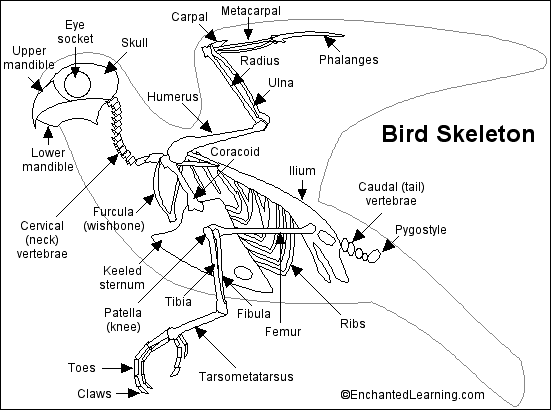
And just to point out something not entirely unrelated check out the hip structure on this bird skeleton he clearly shares something with dinosaurs:


Part 1, Part 2

Source

Holtz, T.R., Jr., and M.K. Brett-Surman. 1997. The osteology of the dinosaurs. In J.O. Farlow and M.K. Brett-Surman (eds.), The Complete Dinosaur, pp. 78-106. Bloomington: Indiana University Press.

Wednesday, May 5, 2010

Dinosaur blood and polystrate trees

So Potholer54debunks (a subsidiary of Potholer54) has a new video out in which he debunks the common creationist claims about dinosaur blood found in fossils and polystrate trees, trees that "cut through multiple sedimentary layers."


As always this is another good video by him and he makes a good point. If you hear a scientific claim in the common press, or from your creationist friends, go to the actual source. Google has this thing called Google Scholar it is good for finding scientific papers. I recently blogged about why it was important to read the original source, wow I don't know how to phrase that sentence so I don't sound like an arrogant ass.

Friday, April 30, 2010

Why Dinosaurs are not just big lizards, Part 2

Part 1, Part 3

So last time we talked about the obvious differences between dinosaurs and lizards in this one we will talk a little more in depth about these differences.

Stance

So we have all probably seen alligators and lizards walking if you haven't check out the videos below:


You will probably notice that they way that they are walking has their feet in a position that is not directly under their body. Now look at the way you or your dog/cat/other mammal walks you will notice that the feet of the mammals are placed directly under the body. This allows these organisms to better support their own body weight with less muscle work while at the same time extending the stride length of the animal so you increase the speed without lengthening the legs. So what does this have to do with dinosaurs? Well lets look at dinosaur's closest living relatives, the birds:


Look at where those legs are located, they are right under the body of the bird. If you want to do more just do a google image search for bird legs. Some of you might be saying, "Wait birds are very derived," or, "You are assuming evolution to be correct." The answer to both statements is yes, you will notice that all that we see of the bird leg is actually from the knee down, and yes, so lets just look at dinosaur stance itself.


So what do we notice in those two images? The first thing, and the one most important to this post is the location of the legs they are directly under the body of the dinosaurs. This is a drastic change from that of the lizards and represent a huge improvement in the way that these organisms moved and may have been one of the reasons they were able to conquer the world during the Mesozoic. You be asking why their legs are under them or how do we know this? We will talk about that next time. I can also hear the complaints now, well those are drawing/recreations they aren't proof! True so here try this:


There better?

Part 1, Part 3

Monday, April 26, 2010

Why Dinosaurs are not just big lizards, Part 1

Part 2, Part 3

So with the semester winding down I figured I would take the time to explain the why the common young earth creationists (hence forth known as YEC) use to explain the lack of dinosaurs on the planet now but exist in the fossil record:


Kent is the main person who proliferates this fallacy, although I am sure that Ken Ham does as well, but now that he is behind bars it hasn't been getting quite as much press. He does get one thing right and that is reptiles continue to grow their entire life but he is wrong that dinosaurs are just big lizards and over the next few day/weeks we will discuss why. I will link all of these together so you can pick up from any part of the series and get to any other part. This first one should be pretty obvious to all parties concerned:

Physical Apperance

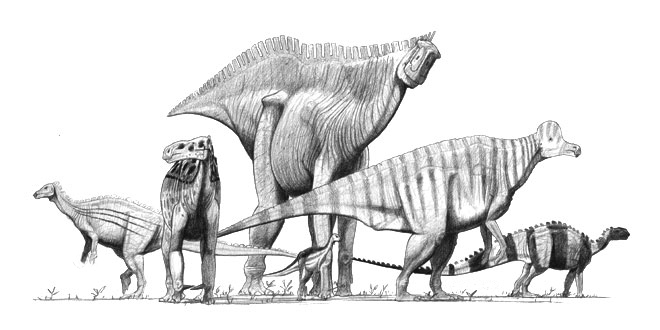
So while there may be some dinosaurs that happen to look like lizards the majority of them look nothing like lizards. Tell me if you have ever seen a lizard that looks like any of these:


Ok so maybe some people have seen the last one:


Lizards or snakes or crocdiles would have to do some major changes during growth in order for this to happen and since the lizards are able to reproduce without these changes it should be pretty obvious that these are not in fact just big lizards.

But even if you exclude dinosaurs and talk about other prehistoric reptiles you might have somethings that are similar to modern lizards and crocs, not counting ancient lizards and crocs,(see here among others) the more famous prehistoric reptiles look nothing like what we have today. So what looks like these YECs:


Although this one some people might say still exists:


Part 2, Part 3

Monday, December 21, 2009

Venomous Dinosaur?

Apparently at least according to the authors of a paper that is about to come out. Based upon this blog post (here) it is hard to tell exactly they have some evidence but nothing certain. I obviously haven't read the paper yet so I can't really say for sure till I do that.

It could always be worse: